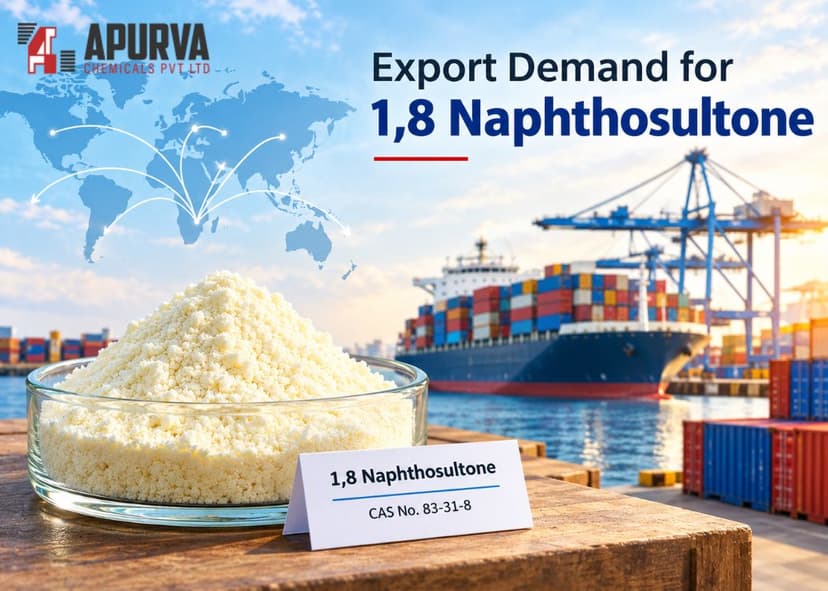
Export Demand for 1,8 Naphthosultone
The international chemical industry continues to rely on specialized intermediates for the production of dyes, pharmaceuticals, and other value-added chemical products. Among these specialty compounds, 1,8-Naphthosultone is an important chemical intermediate used in organic synthesis and industrial applications.
For international buyers, understanding 1,8-Naphthosultone export demand involves more than looking at product availability. Buyers need consistent quality, accurate specifications, reliable documentation, suitable packaging, and dependable shipment schedules. These factors have increased the importance of experienced chemical suppliers that can support both technical and commercial requirements.
Apurva Chemicals supplies a range of dye intermediates and specialty chemicals from India, including 1,8-Naphthosultone (CAS 83-31-8). The company operates from Vapi, Gujarat, an established chemical manufacturing region, and serves industrial customers seeking reliable chemical supply.
Why Is 1,8-Naphthosultone Relevant to International Buyers?
Demand for specialty intermediates is closely connected to downstream manufacturing requirements. Companies purchasing 1,8-Naphthosultone may require the material as a building block or intermediate for further chemical processing.
Its chemical structure makes it relevant to specialized organic synthesis, while supplier databases show that the compound is commercially offered by suppliers across several countries, including India, China, Germany, Japan, the United States, and others. This indicates an established international sourcing ecosystem for CAS 83-31-8 rather than a product restricted to a single geographic market.
For importers, distributors, and manufacturers, this creates several practical sourcing considerations:
Consistent batch-to-batch quality
Clear product identification using CAS 83-31-8
Defined technical specifications
Appropriate export packaging
Reliable production and dispatch schedules
COA and SDS availability
Documentation suitable for international shipments
Communication regarding quantity and destination requirements
These factors are particularly important when an intermediate becomes part of a repeat manufacturing process.
Key Drivers Behind 1,8-Naphthosultone Export Demand
1. Growth in Specialty Chemical Sourcing
International chemical manufacturers increasingly source specialized intermediates from established production regions. Rather than manufacturing every intermediate internally, companies may purchase selected compounds from external suppliers to simplify procurement and maintain production efficiency.
This creates opportunities for suppliers that can provide technically consistent materials in commercially viable quantities.
2. Demand for Reliable Intermediate Supply
A chemical intermediate is often only one component in a larger manufacturing chain. Delays or inconsistent material quality can affect downstream production schedules.
Consequently, buyers evaluating a 1,8-Naphthosultone Supplier generally consider more than price. They may assess production capability, quality-control practices, documentation, packaging, logistics support, and the supplier's ability to handle repeat orders.
3. International Chemical Trade from India
India has an established chemical manufacturing and export ecosystem, particularly in Gujarat and other industrial clusters. Current trade-directory data shows significant international shipment activity for Indian dye-intermediate suppliers, reflecting the country's role in global chemical sourcing.
For overseas buyers, sourcing from an Indian 1,8-Naphthosultone Exporter can provide access to established chemical manufacturing infrastructure and export-oriented supply chains.
4. Specialized Applications
1,8-Naphthosultone is documented for use in organic synthesis and as a pharmaceutical intermediate.
Its use in specialized chemical processes means buyers may have precise technical requirements. Instead of selecting a supplier solely according to product name, procurement teams typically need to verify whether the material matches their intended process and internal specifications.
What Should Buyers Look for in a 1,8-Naphthosultone Exporter?
Selecting an exporter requires technical and commercial evaluation. A suitable supplier should be able to clearly communicate product specifications and provide the documentation required for procurement and quality verification.
Product Specifications
The first step is confirming the exact product identity:
Product: 1,8-Naphthosultone
CAS Number: 83-31-8
Molecular Formula: C10H6O3S
Molecular Weight: Approximately 206.22 g/mol
These identifiers help buyers distinguish the material from similarly named naphthalene-based compounds.
Quality Documentation
International buyers may request a Certificate of Analysis (COA) to verify the batch against agreed specifications. An SDS is also important for safe handling, storage, transportation, and regulatory review.
Depending on the destination and transaction, buyers may also require additional commercial or origin-related documentation.
Packaging
Packaging should be selected according to the product's physical characteristics, shipment quantity, transportation method, and buyer's handling requirements.
For bulk international orders, exporters should be able to discuss appropriate industrial packaging and labeling before shipment.
Supply Consistency
A supplier's ability to maintain consistent quality across repeat batches is an important procurement consideration. This is particularly relevant for manufacturers that use intermediates continuously rather than as one-time purchases.
1,8-Naphthosultone Export Opportunities from India
India's chemical sector provides an established base for international sourcing. Gujarat, in particular, has a significant concentration of chemical and pharmaceutical manufacturing activity.
Apurva Chemicals is based in Vapi, Gujarat, and its product portfolio includes 1,8-Naphthosultone (CAS 83-31-8) along with other dye intermediates such as Resist Salt, Metanilic Acid, 1,6-Cleve's Acid, 1,7-Cleve's Acid, BDSA, Peri Acid, and Rhoduline Acid.
For overseas buyers, this broader product portfolio can be relevant when multiple intermediates are required from the same sourcing partner. Consolidated procurement can simplify communication, documentation, quality coordination, and logistics planning.
How Buyers Can Evaluate 1,8-Naphthosultone Suppliers
Before placing a commercial order, procurement teams can use a structured evaluation process:
1. Confirm chemical identity: Verify the product name, CAS number, molecular formula, and required grade.
2. Define technical requirements: Share the required purity, appearance, testing parameters, and any customer-specific specifications.
3. Request documentation: Obtain the COA, SDS, specification sheet, and other documents relevant to the destination market.
4. Discuss packaging: Confirm pack size, labeling, palletization, and export packaging requirements.
5. Confirm commercial quantities: Discuss sample requirements, trial quantities, regular order volumes, and minimum order quantities.
6. Review logistics: Confirm production lead time, dispatch schedule, shipping terms, destination port, and required export documentation.
7. Establish repeat-supply expectations: For regular procurement, discuss forecast quantities and production planning in advance.
This approach helps importers compare suppliers using objective procurement criteria rather than relying only on quoted price.
Future Outlook for 1,8-Naphthosultone Export Demand
The outlook for specialty intermediates is closely linked to downstream demand from chemical manufacturing, pharmaceutical synthesis, dyes, and other industrial sectors. As manufacturers continue to source specialized chemical building blocks internationally, suppliers that combine product consistency with documentation and dependable logistics can remain relevant to global procurement teams.
However, demand can vary by application, region, regulatory requirements, and individual buyer specifications. Therefore, purchasing decisions should be based on current technical requirements and verified supplier information rather than generalized market assumptions.
For buyers searching for a 1,8-Naphthosultone Exporter or 1,8-Naphthosultone Supplier, India represents one established sourcing location, while supplier selection should ultimately depend on product specifications, quality requirements, commercial terms, and export capability.
Why Choose Apurva Chemicals for 1,8-Naphthosultone?
Apurva Chemicals is an Indian manufacturer, supplier, and exporter of dye intermediates and specialty chemicals. Its portfolio includes 1,8-Naphthosultone (CAS 83-31-8), supporting industrial buyers looking for specialized chemical intermediates.
The company states that it has an established quality-control laboratory, an R&D team, and manufacturing operations in Vapi, Gujarat. These capabilities support its focus on consistent product quality and industrial supply.
For buyers evaluating 1,8-Naphthosultone for international procurement, Apurva Chemicals can discuss product specifications, quantity requirements, packaging, documentation, and export requirements based on the intended application and destination.
Request a Quote for 1,8-Naphthosultone
Looking for a reliable 1,8-Naphthosultone Supplier for your industrial or export requirements?
Contact Apurva Chemicals to discuss your required grade, quantity, packaging, documentation, and destination. Our team can provide product information and commercial details for 1,8-Naphthosultone CAS 83-31-8 according to your procurement requirements.