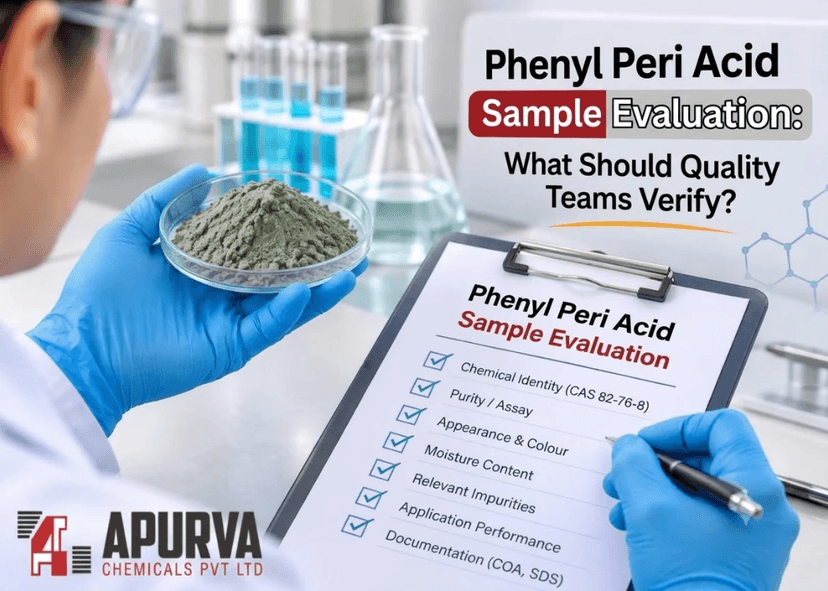


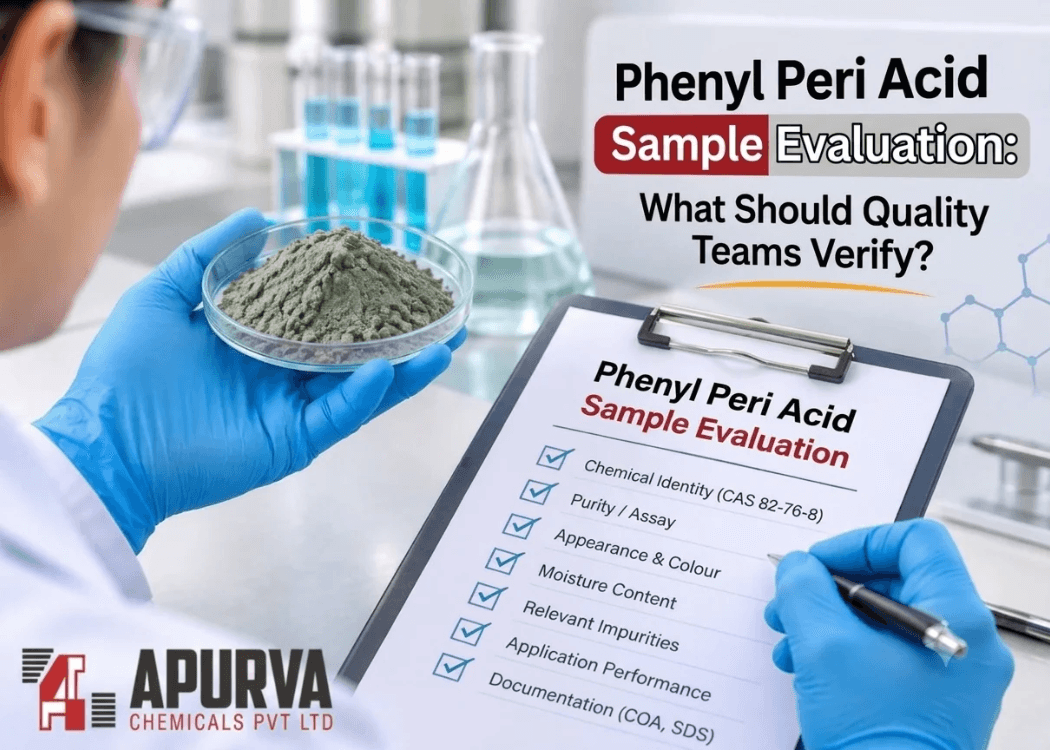
Phenyl Peri Acid Sample Evaluation: What Should Quality Teams Verify?
Before purchasing an industrial chemical in bulk, manufacturers need to confirm that the material meets their quality and production requirements. A supplier's product description may provide basic information, but evaluating an actual sample helps quality teams make a more informed decision.
This is particularly important when sourcing Phenyl Peri Acid, a specialty dye intermediate identified by CAS No. 82-76-8. Its suitability for a manufacturing process depends on factors such as chemical identity, purity, physical condition, relevant impurities and application requirements.
For dye manufacturers, pigment producers and chemical procurement teams, sample approval should therefore involve more than a visual inspection. A structured evaluation helps identify potential quality concerns before a commercial order is placed.
This guide explains the key parameters buyers should verify when evaluating a Phenyl Peri Acid sample and what to discuss with a manufacturer or supplier before approving bulk procurement.
What Is Phenyl Peri Acid?
Phenyl Peri Acid is an aromatic chemical intermediate used in selected dye, pigment and specialty chemical manufacturing processes. It is identified by CAS number 82-76-8, has the molecular formula C₁₆H₁₃NO₃S and a molecular weight of approximately 299.34 g/mol.
It is important not to confuse Phenyl Peri Acid with Peri Acid, which is a separate chemical identified by CAS No. 82-75-7. Buyers should verify the chemical name and CAS number on quotations, product specifications and sample labels before proceeding.
Confirming the correct identity is the first step in ensuring that the material being evaluated matches the intended industrial requirement.
Why Is Sample Evaluation Important Before Bulk Procurement?
A sample gives buyers an opportunity to assess a chemical before committing to a larger quantity. It also helps establish whether the supplier's declared specifications align with the buyer's technical expectations.
For quality and procurement teams, sample evaluation helps to:
Confirm the chemical identity and agreed product grade.
Review purity and other relevant analytical parameters.
Identify unusual physical characteristics or visible contamination.
Assess suitability through controlled laboratory trials.
Establish measurable acceptance criteria for commercial orders.
Create a reference for evaluating future deliveries.
A documented evaluation also improves communication between the buyer and supplier. Instead of relying on general descriptions such as high quality, both parties can discuss specific test results and agreed requirements.
Key Parameters to Verify During Phenyl Peri Acid Sample Evaluation
The following checks provide a practical starting point. The exact tests and acceptance limits should be agreed according to the intended application and product specification.
1. Confirm Chemical Identity
Begin by checking whether the sample is correctly identified as Phenyl Peri Acid.
Verify these details:
Chemical name: Phenyl Peri Acid
CAS number: 82-76-8
Molecular formula: C₁₆H₁₃NO₃S
Molecular weight: Approximately 299.34 g/mol
Also record the supplier's sample reference, batch or lot number and date of receipt, wherever available.
This information helps avoid confusion when evaluating multiple dye intermediates or comparing samples from different suppliers. Any mismatch between the sample label and supporting documents should be clarified before testing.
2. Examine Appearance and Physical Condition
Appearance is a useful preliminary check, although it cannot establish chemical purity.
Apurva Chemicals' published product information describes Phenyl Peri Acid as a grey to greenish wet powder. Buyers should compare the received material with the current product specification rather than relying on colour alone.
Quality teams should examine:
Colour: Check whether it matches the agreed product description.
Physical form: Confirm that the material has the expected form.
Uniformity: Look for unusual variations within the sample.
Foreign particles: Note any visible unwanted material.
Condition: Check for signs of moisture exposure, damaged packaging or deterioration.
If the sample looks different from the agreed reference, document the observation and request clarification from the supplier.
3. Review Assay and Purity
Assay is an important parameter when assessing a chemical raw material. It indicates the amount of the intended chemical in the tested material, according to the specified analytical method.
However, a higher purity percentage does not automatically guarantee better suitability for every application. The required assay depends on the intended process and agreed product grade.
Before approving a sample, ask the Phenyl Peri Acid supplier:
What is the specified minimum assay?
What is the actual result for the submitted sample?
Which analytical method was used?
Are the acceptance limits clearly documented?
Does the result meet the buyer's requirements?
Always compare the reported result with the agreed specification rather than making a decision based on an advertised purity figure.
4. Check Moisture and Relevant Impurities
Moisture and impurities may influence the suitability of an industrial chemical for a particular process. Their acceptable levels should be defined according to the product grade and application.
Buyers should clarify whether moisture content and relevant impurities are included in the supplier's specification. They should also ask which analytical methods are used and whether actual test results are available.
Not every application requires the same impurity profile. Therefore, quality teams should identify the parameters that matter to their manufacturing process instead of applying generic limits without technical justification.
5. Conduct a Controlled Application Trial
Laboratory results provide useful information, but they may not fully establish how a sample will behave in a particular manufacturing process.
Where appropriate, conduct a controlled trial using the company's established procedure. Compare the sample with an approved reference material, if available.
Depending on the application, the technical team may assess:
Behaviour under the intended reaction conditions.
Compatibility with the established synthesis route.
Process observations and consistency.
Any unusual changes during processing.
Relevant characteristics of the resulting product.
Keep test conditions consistent when comparing different samples. A successful laboratory trial should also not be treated as automatic proof of performance at full production scale.
What Documents Should Buyers Request?
Documentation helps buyers verify the material and maintain traceability throughout procurement.
Document | What to verify |
Product specification | Agreed quality parameters and acceptance limits |
Certificate of Analysis (COA) | Batch or sample-specific test results |
Safety Data Sheet (SDS) | Handling, storage and safety information |
Sample identification | Product name, sample reference and traceability details |
A COA should relate to the identified sample or batch wherever applicable. A general specification sheet describes the intended product requirements but does not replace actual test results.
The SDS serves a different purpose: it provides safety information and should not be used as proof of chemical quality.
How Should Quality Teams Record Sample Approval?
Sample approval should be documented rather than based only on verbal confirmation. A simple evaluation record can help quality, procurement and production teams work with the same information.
Include:
Product name and CAS number.
Supplier and sample reference.
Appearance and physical observations.
Assay and other analytical results.
Relevant impurity and moisture results.
Application trial observations, where applicable.
Comparison against the agreed specification.
Final decision: approved, rejected or further testing required.
How to Choose a Reliable Phenyl Peri Acid Supplier
Sample quality is only one part of supplier evaluation. Buyers should also consider whether the company can support their requirements beyond the initial sample.
When evaluating Phenyl Peri Acid manufacturers, suppliers and exporters, consider:
Availability of current product specifications and COAs.
Clear communication about technical requirements.
Quality-control procedures and batch documentation.
Suitable packaging and labelling.
Ability to discuss quality deviations.
Order quantities and expected delivery timelines.
Export documentation and destination-specific requirements.
A manufacturer is directly involved in producing the chemical, while a supplier may source and distribute it. An exporter handles the commercial and logistical requirements of international shipments. Some companies perform all three roles.
For repeat procurement, agree on the product specification and documentation expectations before confirming the first commercial order.
Why Choose Apurva Chemicals?
Established in 1988, Apurva Chemicals is a manufacturer, supplier and exporter of dye intermediates and specialty chemicals in India. Based in Vapi, Gujarat, the company has more than 35 years of industry experience. Its published company information highlights ISO 9001:2015 certification, a quality-control laboratory and a Research & Development team.
Industrial buyers can review the Phenyl Peri Acid product details and contact the company to discuss specifications, sample requirements, documentation and commercial quantities.
Common Mistakes to Avoid During Sample Evaluation
Before approving a sample, avoid these common mistakes:
Checking appearance alone: Visual inspection cannot confirm chemical purity.
Ignoring chemical identification: Always verify CAS 82-76-8.
Using unclear acceptance limits: Agree on measurable specifications before testing.
Comparing samples under different conditions: Inconsistent test procedures can affect results.
Approving without documentation: Retain test reports and approval records.