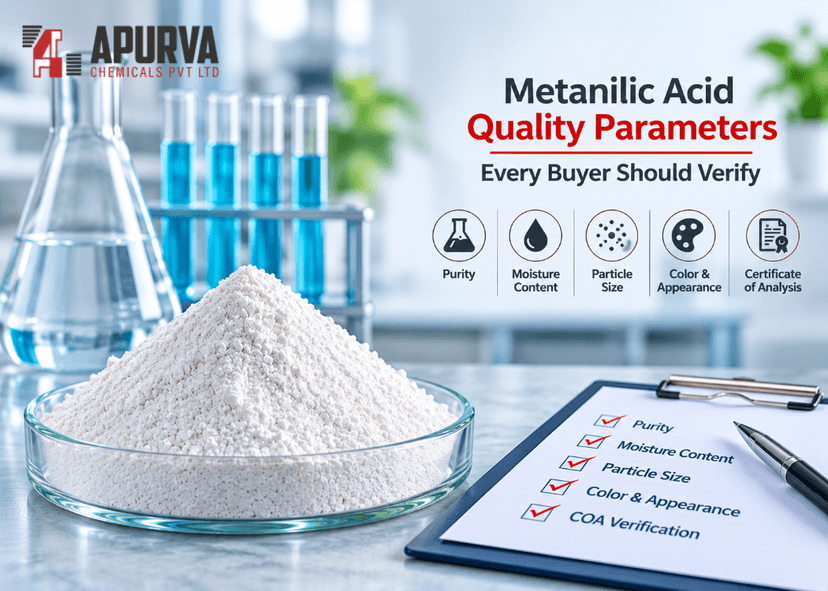


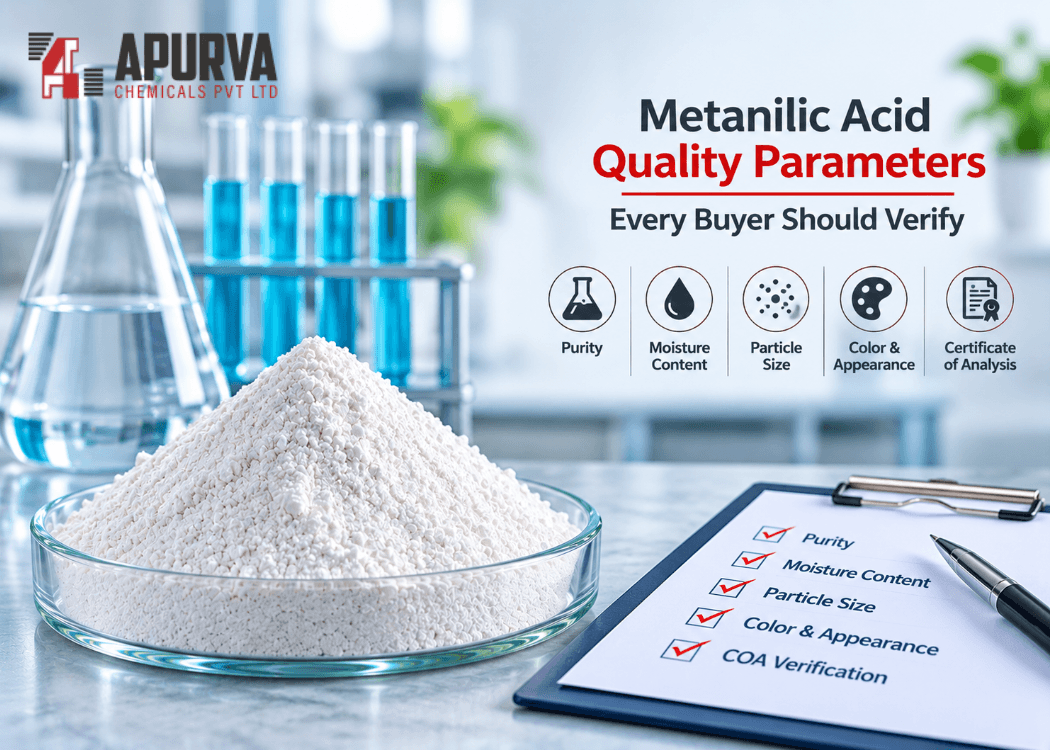
Metanilic Acid Quality Parameters Every Buyer Should Verify
When purchasing an industrial chemical, a product name alone is not enough to establish whether it meets your production requirements. Two suppliers may offer Metanilic Acid under the same CAS number, but differences in product grade, purity, impurities and batch consistency can affect its suitability for a particular application.
For dye manufacturers and chemical procurement teams, checking these details before confirming an order is an important part of supplier evaluation. Metanilic Acid, also known as 3-aminobenzenesulfonic acid, is identified by CAS No. 121-47-1 and is used as a chemical intermediate in dye and other specialty chemical manufacturing.
So, what should buyers actually verify? This guide explains the important quality parameters, supporting documents and supplier questions to consider when sourcing Metanilic Acid.
Confirm Chemical Identity Before Reviewing Quality
The first step is to confirm that the material being offered is the chemical you require. Similar product names or incomplete descriptions can create confusion during procurement, particularly when purchasing multiple chemical intermediates.
For Metanilic Acid, buyers should check the following identification details:
Chemical name: Metanilic Acid
CAS number: 121-47-1
Chemical synonym: 3-Aminobenzenesulfonic Acid
Molecular formula: C₆H₇NO₃S
Molecular weight: 173.19 g/mol
The CAS number is especially useful because it provides a standard chemical identifier across supplier quotations, technical documents and safety data sheets.
Before placing an order, compare the product name and CAS number on the quotation, specification sheet and Certificate of Analysis (COA). Any mismatch should be clarified with the supplier before the material is accepted.
Check Assay and Purity Against Your Required Grade
Purity is one of the first parameters industrial buyers examine when evaluating a Metanilic Acid supplier. It indicates the proportion of the intended chemical in the tested material, as determined by the specified analytical method.
However, a higher advertised purity figure does not automatically make a product suitable for every application. The required grade depends on the buyer's manufacturing process, reaction conditions and downstream product specifications.
For example, Apurva Chemicals lists 98% purity for Metanilic Acid on its product page. Buyers should confirm the applicable specification and the actual batch result through the supplier's current documentation.
When reviewing purity, ask:
What is the agreed minimum assay?
Which analytical method is used?
Is the reported result from the current production batch?
Does the COA mention the test method and reporting basis?
Are the acceptance limits clearly stated?
A clear agreement on assay requirements helps prevent disagreements after delivery.
Examine Appearance, Colour and Physical Condition
Appearance is a simple but useful preliminary quality check. Metanilic Acid is generally supplied as a powder or crystalline solid, and its appearance should be consistent with the agreed product specification.
Buyers should check the following:
Colour: Confirm that the material matches the approved reference or specification.
Physical form: Check whether the supplied material is a powder or crystalline product as agreed.
Uniformity: Look for unusual variations between different portions of the material.
Foreign matter: Check for visible contamination or unwanted particles.
Condition on receipt: Note any signs of moisture exposure, damaged packaging or material deterioration.
Appearance alone cannot establish chemical purity. A product that looks acceptable may still contain impurities or fail its assay requirement. Therefore, visual inspection should be treated as an initial check alongside laboratory testing and batch documentation.
Review Moisture and Impurity Levels
Moisture and impurities are important considerations when evaluating chemical raw materials. Their acceptable levels should be defined according to the product grade and the buyer's intended application.
Excess moisture may affect the physical condition of a powder, while unwanted impurities can influence its suitability for a downstream process. Buyers should therefore avoid relying on general statements such as "high purity" without supporting test results.
Ask the Metanilic Acid manufacturer to clarify:
Whether moisture content is included in the product specification.
Which method is used to determine moisture, where applicable.
Whether relevant impurities are tested individually or reported through another parameter.
What limits apply to the agreed grade.
Whether the latest batch results are available for review.
Not every supplier specification will contain an identical list of impurity tests. The important point is to identify the parameters that matter to your process and agree on measurable acceptance limits before ordering.
Understand the Certificate of Analysis (COA)
A Certificate of Analysis is one of the most useful documents for verifying the quality of an industrial chemical. It records test results for a particular batch and allows buyers to compare actual results with agreed specifications.
When reviewing a COA for Metanilic Acid (CAS 121-47-1), check whether it includes:
COA detail | What buyers should verify |
Product identification | Correct chemical name and CAS number |
Batch or lot number | Traceability to the supplied material |
Test parameters | Relevant quality characteristics |
Specification limits | Agreed acceptance criteria |
Actual test results | Recorded values for the batch |
Test methods | Methods used for the reported results |
Issue details | Date and authorised approval, where applicable |
A COA should relate to the actual batch being supplied. A generic specification sheet can describe the intended product grade, but it does not replace batch-specific test results.
Buyers should also retain the COA with their purchase and incoming inspection records. This makes future comparisons and quality investigations easier.
Compare Batch Consistency, Not Just One Test Report
A batch may meet the agreed specification and still raise questions if its results differ significantly from previous deliveries. For manufacturers using Metanilic Acid regularly, consistency between batches is an important part of supplier performance.
Procurement and quality teams should maintain records of previous COAs and compare relevant parameters across deliveries. This can help identify recurring variations and provide a basis for discussing quality expectations with the supplier.
Before entering into repeat-order arrangements, ask the supplier:
Can batch-specific COAs be provided with deliveries?
How are quality deviations investigated?
Is there a defined process for communicating specification changes?
Can the supplier discuss recurring variations with the buyer's quality team?
A documented approach to batch comparison supports better raw material control and more informed purchasing decisions.
Verify Packaging, Labelling and Safety Documentation
Quality verification does not end with laboratory results. Packaging and documentation also influence how safely and reliably a chemical can be transported, received and handled.
Before dispatch, confirm that the packaging is suitable for the product and agreed delivery conditions. Check that bags or containers are properly closed, protected against moisture exposure where required and labelled with the relevant product and batch information.
Buyers should also request the current Safety Data Sheet (SDS) and review its handling, storage, exposure-control and emergency guidance. The SDS is a safety document; it should not be treated as a substitute for the COA or product specification.
Clear documentation helps purchasing, warehouse, quality and production teams work with the same product information.
Why Source Metanilic Acid from Apurva Chemicals?
Apurva Chemicals is an Indian manufacturer, supplier and exporter of dye intermediates and specialty chemicals, established in 1988. Based in Vapi, Gujarat, the company has more than 35 years of industry experience and operates with a quality-control laboratory and Research & Development team.
Its product portfolio includes Metanilic Acid (CAS 121-47-1) alongside other dye intermediates such as Resist Salt, Rhoduline Acid, Cleve's Acid and Peri Acid.
Buyers can review the Metanilic Acid product details and discuss current specifications, batch documentation, quantities and packaging requirements directly with the company.
Conclusion
Selecting the right Metanilic Acid supplier requires more than checking a product name or comparing quotations. Buyers should verify chemical identity, assay, appearance, moisture, relevant impurities, batch-specific COAs, packaging and safety documentation.
A clear specification agreement before dispatch helps both the manufacturer and buyer understand the expected quality requirements. It also creates a more reliable basis for repeat orders and supplier evaluation.
Looking for a Metanilic Acid supplier for your industrial requirements? Explore the Apurva Chemicals product range and contact the team to discuss your specifications and sourcing needs.