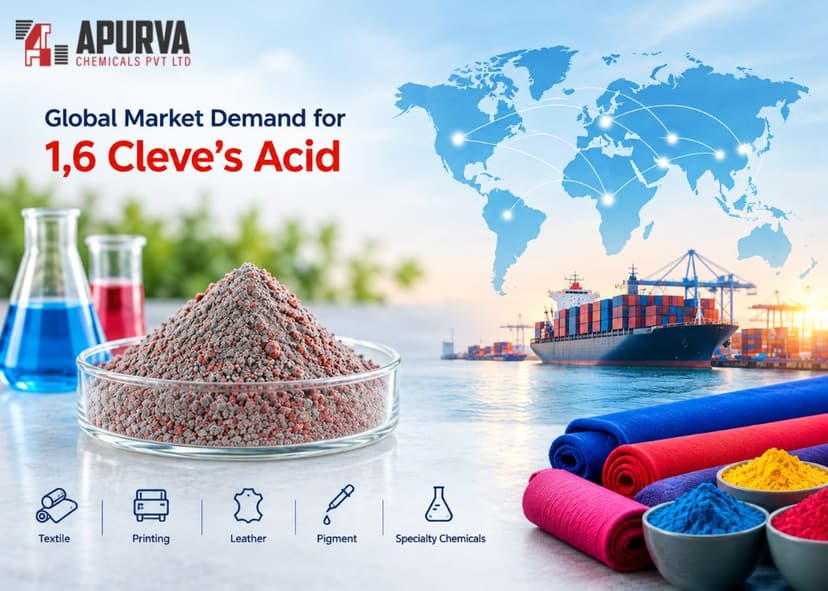
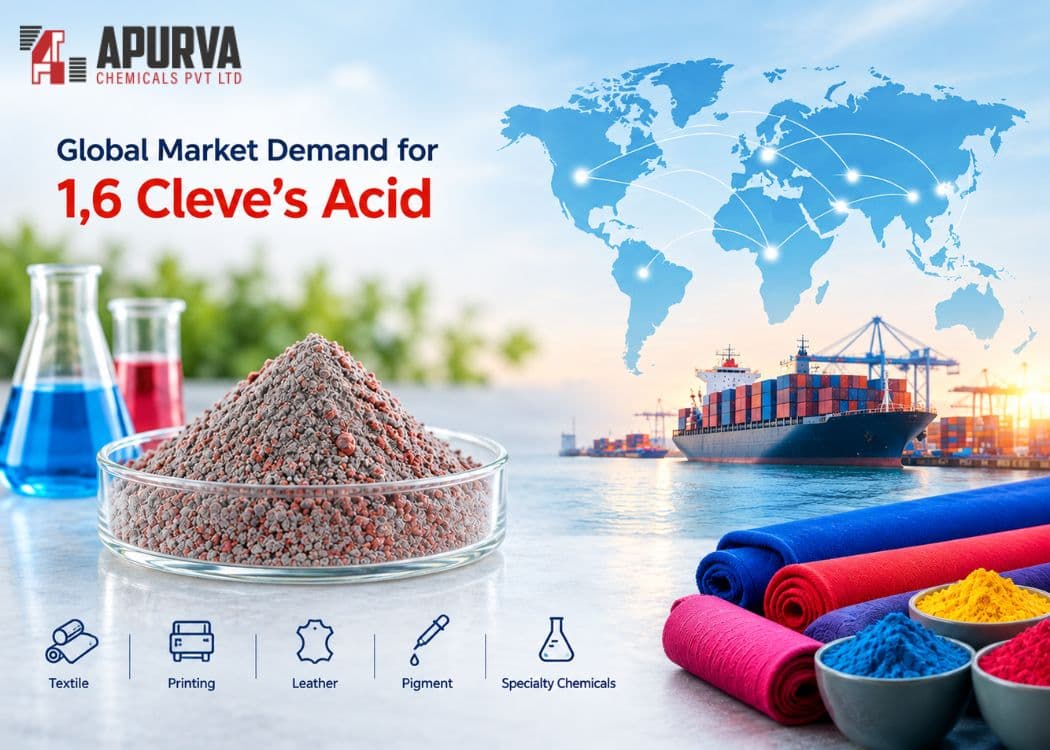
Global Market Demand for 1,6 Cleve's Acid
The global dye and specialty chemical industries depend on a wide range of intermediates to produce consistent, high-performance colorants. Among these, 1,6 Cleve's Acid is an important aminonaphthalenesulfonic acid intermediate used in dye and colorant chemistry. Also identified as 5-amino-2-naphthalenesulfonic acid, it has the CAS number 119-79-9, molecular formula C₁₀H₉NO₃S, and molecular weight of approximately 223.25 g/mol.
As textile, printing, leather, pigment, and specialty colorant manufacturing continues to require dependable chemical intermediates, interest in 1,6 Cleve's Acid market demand is closely connected with developments in downstream dye manufacturing. For buyers, manufacturers, and distributors, understanding the factors influencing the 1,6 Cleve's Acid global market can help with sourcing, production planning, and supply-chain decisions.
Why Is 1,6 Cleve's Acid Important to the Dye Industry?
The 1,6 Cleve's Acid market is closely associated with the broader demand for dye intermediates. These chemicals are used as starting materials or building blocks in multi-step synthesis, where their molecular structure contributes to the properties of the resulting colorant.
Dye intermediates are used across textile dyeing and printing as well as other color-intensive industries. Their importance comes from their role earlier in the manufacturing chain: the quality and consistency of an intermediate can influence downstream processing and the reproducibility of finished products.
Apurva Chemicals' broader dye-intermediate portfolio includes products used across textile, printing, pigment, and related applications.
This means demand for individual intermediates such as 1,6 Cleve's Acid should be viewed within the context of downstream manufacturing requirements rather than as an isolated chemical market.
Key Factors Influencing 1,6 Cleve's Acid Market Demand
Several factors can influence demand for 1,6 Cleve's Acid globally.
1. Growth of Textile Manufacturing
Textile manufacturing remains an important consumer base for synthetic dyes and related intermediates. As textile production develops across Asia and other manufacturing regions, chemical suppliers need to support consistent availability of the intermediates used in dye synthesis.
The relationship is indirect: higher textile production does not automatically translate into a specific increase in 1,6 Cleve's Acid consumption. However, continued activity in dye manufacturing creates an underlying market requirement for suitable intermediate chemicals.
2. Demand for Consistent Colorants
Modern dye manufacturers require consistency from batch to batch. Color strength, shade, solubility, reaction behavior, and downstream processing requirements can all affect the selection of intermediates.
For this reason, buyers increasingly evaluate suppliers not only on price but also on quality consistency, technical specifications, documentation, and supply reliability.
3. Expansion of Specialty Chemical Applications
The role of dye intermediates extends beyond conventional textile applications. Certain intermediates can also contribute to the synthesis of pigments and specialty colorants.
Apurva Chemicals describes 1,6 Cleve's Acid as an intermediate for dyestuffs and lists applications associated with textile, printing, leather, and industrial uses.
As manufacturers develop specialized color formulations, the requirement for appropriately specified intermediates can create additional procurement opportunities.
4. International Chemical Trade
The 1,6 Cleve's Acid global market also depends on international sourcing. Chemical manufacturers and distributors often procure intermediates from established production centers and supply them to downstream industries in different regions.
India has an established chemical and dye-intermediate manufacturing base, making Indian suppliers relevant to international buyers looking for export-oriented chemical sourcing.
For global buyers, factors such as production capacity, quality controls, export documentation, packaging, lead times, and logistics can be as important as the quoted product price.
Role of India in the 1,6 Cleve's Acid Supply Chain
India has a well-established chemical manufacturing ecosystem, particularly in Gujarat and other industrial regions. The country's dye and chemical sectors support both domestic consumption and international trade.
A reliable 1,6 Cleve's Acid manufacturer can therefore play an important role in maintaining continuity for downstream dye producers. However, buyers should assess suppliers based on their actual technical and commercial requirements rather than relying solely on country of origin.
Important supplier evaluation points include:
Product identity and CAS number
Purity and agreed specifications
Batch-to-batch consistency
Certificate of Analysis (COA)
Safety Data Sheet (SDS/MSDS)
Packaging options
Production and dispatch lead time
Export documentation
Technical communication
Ability to support repeat orders
Apurva Chemicals currently lists 1,6-Cleve's Acid (CAS 119-79-9) within its dye-intermediate range and provides product specifications and documentation options such as COA and SDS/MSDS.
What Buyers Look for in a 1,6 Cleve's Acid Supplier
A 1,6 Cleve's Acid supplier needs to provide more than a product name and quotation. Industrial buyers generally need enough information to determine whether the material fits their process and procurement requirements.
Before purchasing, buyers should request the latest specification sheet and COA and verify:
Chemical identity: Confirm that the material corresponds to CAS 119-79-9.
Purity: Establish the required purity level according to the intended synthesis or application.
Physical characteristics: Confirm appearance and other agreed specifications.
Documentation: Request COA, SDS/MSDS, and other relevant export or quality documents.
Packaging: Select packaging appropriate for the shipment quantity, storage conditions, and destination.
Supply capability: Discuss MOQ, lead time, production availability, and repeat-order requirements.
These checks can reduce the risk of receiving material that does not match the customer's process specifications.
How Quality Can Influence Global Demand
In specialty chemical procurement, demand is not determined only by volume. Quality consistency can strongly influence supplier selection and repeat purchasing.
A dye manufacturer may use an intermediate repeatedly across a defined production process. If incoming material varies significantly between batches, it can create challenges in downstream processing and quality control.
This is why a dependable 1,6 Cleve's Acid manufacturer should maintain documented specifications and appropriate quality-control procedures. Buyers can then compare the supplier's COA with their internal requirements before approving the material.
For international customers, this becomes even more important because returning or replacing chemical shipments can involve additional logistics, customs procedures, and production delays.
Future Outlook for 1,6 Cleve's Acid
The future 1,6 Cleve's Acid market demand will largely depend on the performance of its downstream applications and the broader dye-intermediate industry.
Several developments are likely to remain important:
Continued demand for synthetic colorants
Growth and restructuring of textile manufacturing
Increasing requirements for consistent chemical quality
Expansion of specialty and high-performance colorants
Greater emphasis on responsible chemical manufacturing
Diversification of international chemical supply chains
Demand for reliable export-oriented suppliers
It is important to distinguish these industry drivers from a precise market forecast. Publicly available sources establish the chemical identity and known industrial role of 1,6 Cleve's Acid, but they do not by themselves provide a reliable, independently verified global market-size forecast for this specific compound. Therefore, purchasing decisions should be based on actual application requirements, supplier capability, specifications, and current commercial quotations rather than unsupported market-size estimates.
Why Supplier Selection Matters
As international buyers become more careful about chemical sourcing, supplier selection is becoming an important part of procurement strategy.
A suitable 1,6 Cleve's Acid supplier should be able to communicate clearly about product specifications, documentation, packaging, availability, and shipment requirements. For manufacturers purchasing repeatedly, consistency and responsive technical support can help simplify procurement planning.
Apurva Chemicals supplies dye intermediates from India and lists 1,6 Cleve's Acid among its products. Its product information identifies the material as CAS 119-79-9 and provides specification and documentation options for buyers.
Conclusion
1,6 Cleve's Acid is an important chemical intermediate associated with dye and colorant manufacturing. Its global demand is influenced by downstream industries such as textiles, printing, leather, pigments, and specialty colorants.
As international manufacturers continue to focus on consistent quality and dependable chemical sourcing, the role of a capable 1,6 Cleve's Acid manufacturer and 1,6 Cleve's Acid supplier becomes increasingly important.
For businesses evaluating suppliers, the key considerations should include chemical identity, purity, specifications, COA, SDS/MSDS, packaging, lead time, export capability, and consistency. With the right sourcing approach, manufacturers can better integrate 1,6 Cleve's Acid into their existing procurement and production requirements.