

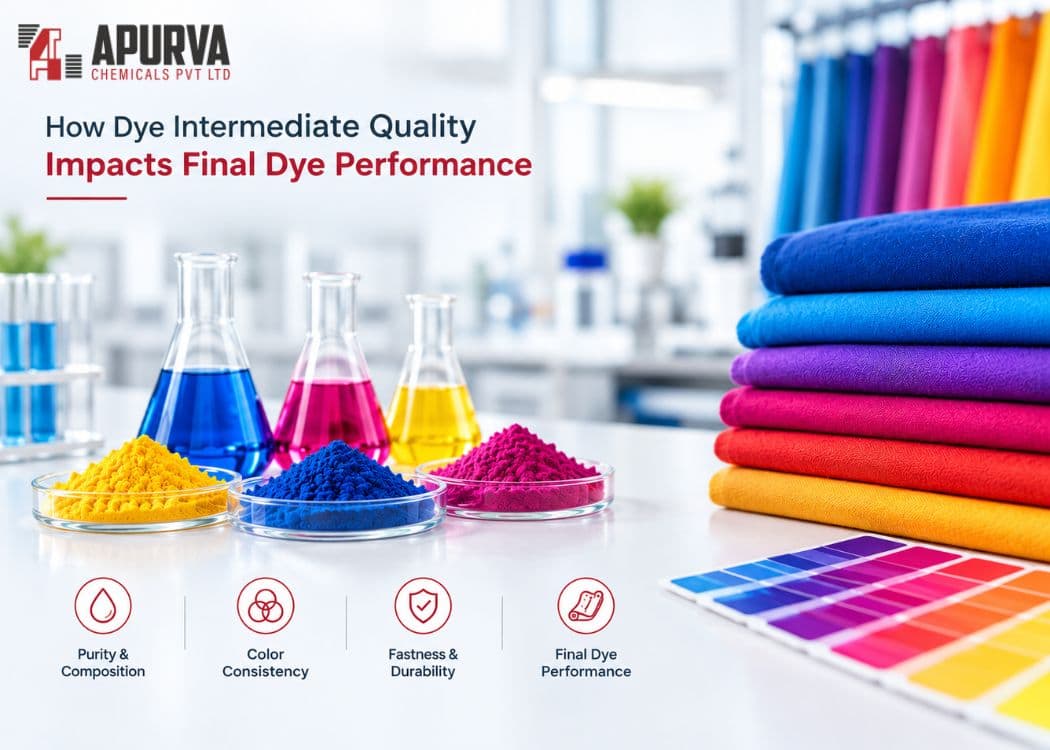
How Dye Intermediate Quality Impacts Final Dye Performance
A dye batch can miss its standard even when the recipe is correct and every step is followed. The cause often sits earlier in the chain, in the dye intermediates that form the dye's backbone. Every later reaction builds on them, so a small flaw at the start can become a visible defect at the end.
Apurva Chemicals has manufactured chemical intermediates for dyes in Vapi, Gujarat, since 1988. Over those years we have seen that a process can be fine-tuned, but a flawed starting material cannot be fully corrected. This article explains how dye intermediate quality shapes final dye performance and how to manage it.
What Dye Intermediate Quality Really Covers
Quality is more than one purity figure on a datasheet. It combines several factors:
Assay: the real percentage of the target compound
Isomer profile: close positional isomers, such as 1,6- and 1,7-Cleve's Acid, behave differently in coupling
By-products and leftover raw materials: carried over from the intermediate's own synthesis
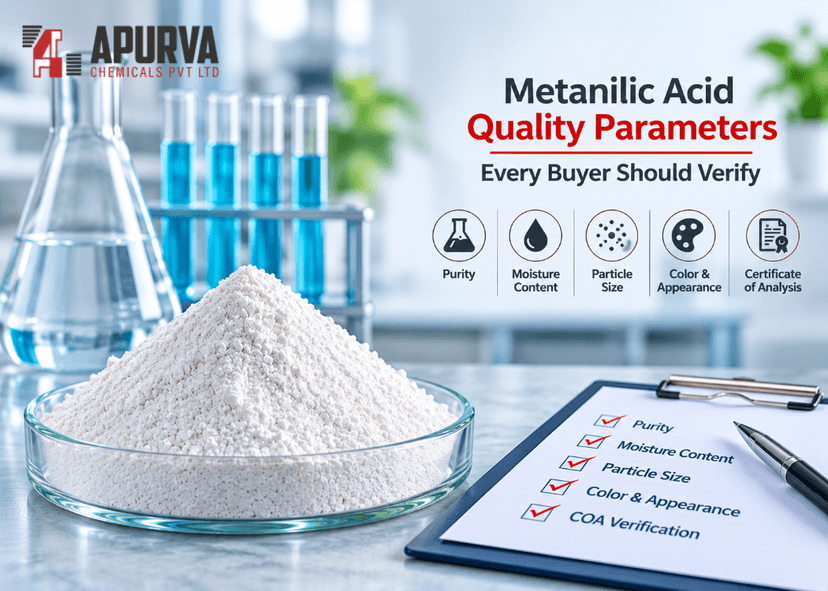
Moisture and insoluble matter: these affect weighing accuracy and solution clarity
Metal traces: especially iron, which can disturb metal-sensitive dyes
Lot-to-lot consistency: the same specification, delivered every time
How Dye Intermediate Purity Shapes the Final Dye
Shade and brightness. During coupling, an isomeric or related impurity can react alongside the main component and form side-products with their own colors. The shade turns duller or drifts from the standard. A pure intermediate reacts predictably and gives a cleaner chromophore.
Strength and yield. Diazotization and coupling depend on exact stoichiometry. If the true assay is lower than declared, the calculation is wrong before the reaction starts. Some reactive capacity goes unused, and color strength falls short.
Fastness. Light, wash, and rubbing fastness depend on how cleanly the dye molecule forms. Residues and side-products add weakly bound components that fail under real use, which later appears as fading or bleeding.
Solubility and application. Insoluble particles and stray salts block filters, leave specks, and cause uneven uptake. In textile and leather processing, that looks like patchiness or streaks, and fixing it after dyeing is slow and costly.
Reproducibility. A supplier whose material varies between lots forces constant recipe adjustments on your side. Tight specifications and process control keep each lot behaving the same way.
Why Impurities Hurt Each Dye Class Differently
Azo dyes depend on both a diazo component and a coupling component being clean. Impurities in an aromatic amine can consume nitrite and create unwanted diazonium species, while impurities in the coupling partner form competing azo compounds.
Reactive dyes often rely on sulphonated naphthalene intermediates. Sulphonic acid content influences solubility, and isomer impurities can alter reactivity and shade.
Pigments can lose tinting strength and brightness when by-products interfere with crystal formation.
How Quality Gets Verified
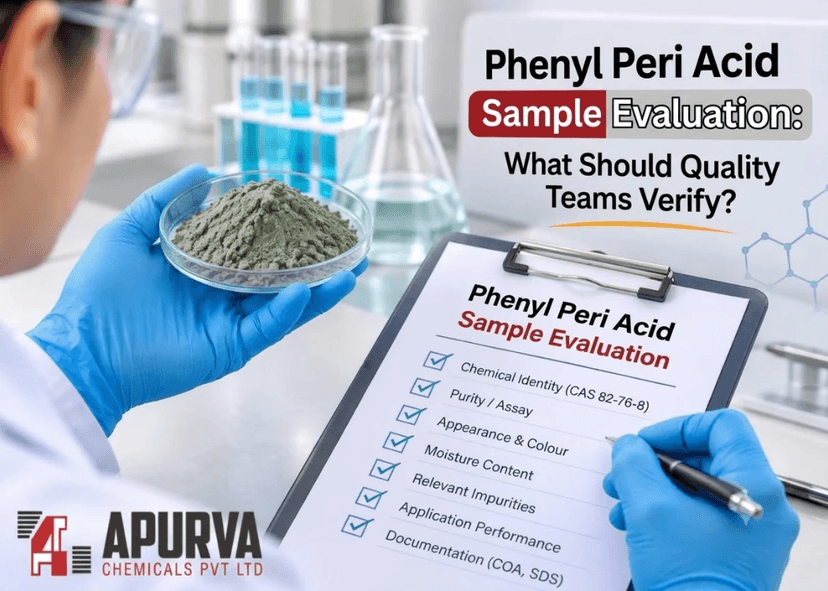
A Certificate of Analysis is only as reliable as the tests behind it. Typical checks include titration for assay, HPLC for isomer ratios and related substances, Karl Fischer or loss-on-drying for moisture, filtration for insoluble matter, and metal analysis where contamination is a concern. Ask which of these a supplier runs in-house, since own-lab testing gives faster feedback and tighter control.
What Cheaper Grades Really Cost
A lower price per kilo looks good on paper. The expense appears later through re-shading, reprocessing, higher material consumption, extra effluent from rework, and rejected lots. Many manufacturers find that high purity dye intermediates cost less across the full production cycle, even at a higher unit price.
Quality and Export Compliance
Export buyers ask for documentation as well as performance. Some markets restrict azo dyes that can release specified aromatic amines, so manufacturers must know what goes into their products. Traceable batches and consistent analytical records make audits and customer compliance requests far easier to handle.
How to Choose a Dye Intermediate Supplier
Look for a batch-wise Certificate of Analysis against agreed specifications, a recognised management certification such as ISO 9001:2015, and R&D support that understands your application. Request trial samples before committing to volume, and confirm that lead times and export paperwork are dependable. A supplier willing to discuss specifications openly is usually one that controls them well.
Mistakes That Undermine Even Good Material
Vague specifications. Naming only the product leaves tolerance limits open. State assay, isomer limits, moisture, and insoluble matter.
No incoming checks. Compare every lot with an approved reference sample, and run a small trial coupling for critical grades.
Careless storage. Moisture pickup and contamination can undo supplier quality, so keep material dry and sealed.
Switching sources without re-validation. The same named product can behave differently from a new supplier.
How Apurva Chemicals Approaches Quality
Apurva Chemicals is an ISO 9001:2015 certified manufacturer and exporter of dye intermediates and industrial chemicals. A specialised quality control laboratory supports our management system, and a dedicated R&D team works on improving products and processes.
Our range includes Peri Acid, Phenyl Peri Acid, Laurent's Acid, 1,6- and 1,7-Cleve's Acid, Metanilic Acid, N-Phenyl J Acid, Rhoduline Acid, and Resist Salt. We produce them at our GIDC factory in Vapi and ship to customers in India and overseas.
Closing Thought
Your customers judge a dye by how it looks and how long it lasts. Much of that is settled before your own process begins, which makes the choice of intermediate partner one of the most valuable decisions in dye manufacturing.
Need Dependable Dye Intermediates?
Consistent dyes begin with consistent raw materials. Apurva Chemicals supplies high purity dye intermediates with in-house quality control, technical support, and prompt delivery.
📩 Request a quote or sample: sales@apurvachem.in
📞 Call us: +91 99137 89309
🌐 Explore our products: www.apurvachemicals.com
Apurva Chemicals Pvt. Ltd. | Factory: Plot No. 2806, 2807/1, 3rd Phase GIDC, Vapi, Gujarat 396195, India