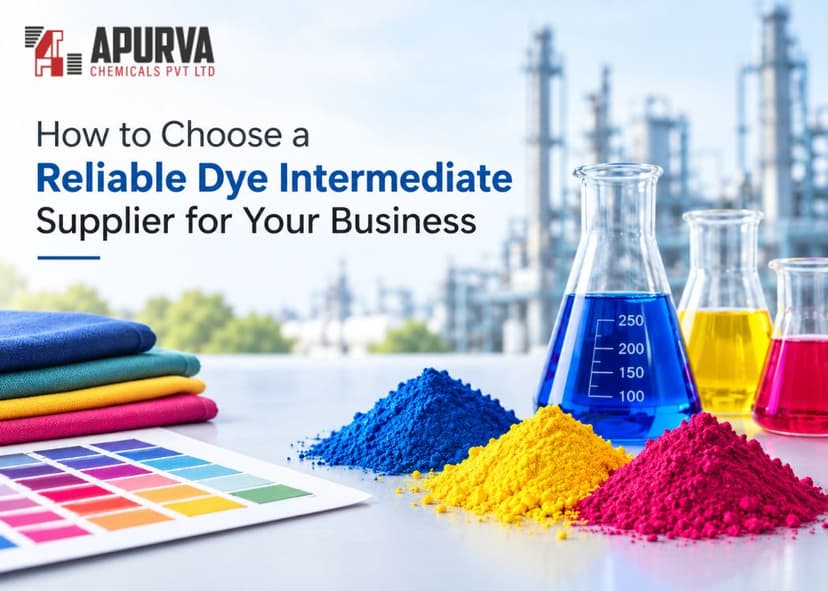
How to Choose a Reliable Dye Intermediate Supplier for Your Business
Somewhere in almost every production manager's career, there's a story about the supplier that looked fine on paper - competitive price, decent website, quick replies - and then fell apart the moment an order actually mattered. A late shipment. A batch that didn't match the COA. A purity level that was "close enough" until it wasn't. In an industry where a few percentage points of purity can change how a dye performs on fabric, "close enough" is an expensive habit.
Choosing a dye intermediate supplier isn't just a procurement decision - it's a quality decision that ripples through your entire production line. Whether you're sourcing Metanilic Acid for azo dye synthesis or Resist Salt for oxidation control in dyeing, the supplier you choose directly affects your consistency, compliance, and bottom line.
At Apurva Chemicals, we've been on the manufacturing side of this relationship for over three decades, and we've seen firsthand what separates a dependable supplier from a risky one. Here's what to actually look for.
Why Supplier Selection Matters More in Dye Intermediates Than in Most Industries
Dye intermediates aren't a commodity you can swap out casually. Small variations in purity, particle size, or moisture content can shift shade output, reaction yield, or reproducibility in downstream processes. A supplier who can't guarantee batch-to-batch consistency isn't just a minor inconvenience - they become a variable your quality control team has to compensate for on every single order.
This is why evaluating a dye intermediate manufacturer in India (or anywhere) needs to go beyond price comparisons. The real cost of an unreliable supplier shows up later - in rejected lots, reprocessing costs, missed export deadlines, and strained customer relationships.
Key Factors to Evaluate Before Choosing a Dye Intermediate Supplier
1. Manufacturing Capability vs. Trading
There's a meaningful difference between a manufacturer and a trader. A manufacturer controls the process from raw material to finished product, which means they can guarantee specifications, adjust for custom requirements, and respond quickly to quality queries. A trader, on the other hand, is often reselling stock they don't fully control - so if there's a batch issue, they have limited ability to fix it. Ask directly: is this company manufacturing in-house, or sourcing and reselling?
2. Consistent Purity and Documentation
Certificate of Analysis (COA) for every batch
Material Safety Data Sheet (MSDS) for safe handling and compliance
Consistent purity levels matching agreed specifications (for example, Metanilic Acid at standard industrial purity, or Resist Salt in 96% and 80% grades)
If a supplier hesitates to share this documentation upfront, treat it as a warning sign, not a formality you can skip.
3. Quality Control Infrastructure
Ask about the supplier's in-house testing capabilities. Do they have a dedicated QC lab? Do they test every batch before dispatch, or only periodically? Manufacturers with robust in-house testing are far less likely to send out material that deviates from spec - because they catch the deviation before it reaches you.
4. Track Record and Industry Experience
Longevity in this industry isn't just a marketing point - it's a signal of process maturity. A supplier that's been manufacturing dye intermediates for decades has likely refined their production, quality control, and logistics processes through years of real-world feedback from demanding customers. Newer suppliers aren't automatically unreliable, but a long-standing track record reduces risk.
5. Regulatory and Export Compliance
If you're importing dye intermediates internationally, compliance isn't optional. Check whether the supplier holds relevant certifications (such as ISO 9001:2015), understands export documentation, and has experience shipping to your region. A supplier unfamiliar with export compliance can turn a straightforward order into a customs delay.
6. Responsiveness and Technical Support
A good supplier doesn't disappear after the invoice is sent. When you have a technical question — dosage guidance, application troubleshooting, or a query about a specific batch — you should get a knowledgeable response, not a generic reply. This kind of technical support often reflects how seriously a supplier takes long-term relationships versus one-off transactions.
7. Supply Reliability and Lead Times
For continuous production units, a supplier's ability to deliver on schedule is as important as product quality. Ask about typical lead times, minimum order quantities, and how they handle unexpected demand spikes. A supplier with strong inventory planning and manufacturing capacity is far less likely to leave your production line waiting.
Red Flags to Watch For
Reluctance to share COA/MSDS before purchase
Vague or inconsistent answers about manufacturing location and process
Pricing significantly below market average with no clear explanation
No verifiable client history or export experience
Poor communication during the inquiry stage - a preview of what post-sale support might look like
A Quick Supplier Evaluation Checklist
Before finalizing a dye intermediate supplier, confirm:
They manufacture in-house (not just trading)
COA and MSDS are provided for every batch
Purity specifications are clearly documented and consistent
They have relevant quality certifications (ISO, etc.)
They have export experience relevant to your region
Technical support is accessible and responsive
Lead times and MOQs align with your production schedule
Why Manufacturers Choose Apurva Chemicals
We work with textile processors, dye manufacturers, and international importers who need a supplier they don't have to double-check on every order - because reliability shouldn't be something you have to hope for.
Final Thoughts
Choosing a dye intermediate supplier is ultimately a risk-management decision. The right partner protects your production consistency, your compliance standing, and your customer relationships downstream. The wrong one quietly costs you in ways that don't always show up until it's too late.
If you're currently evaluating suppliers for Metanilic Acid, Resist Salt, or any other dye intermediate, we'd be glad to walk you through our specifications, documentation, and process - no pressure, just a straightforward conversation about whether we're the right fit for your production needs.
Looking for a dye intermediate supplier you can actually rely on? Get in touch with Apurva Chemicals today for a quotation, sample request, or technical consultation.