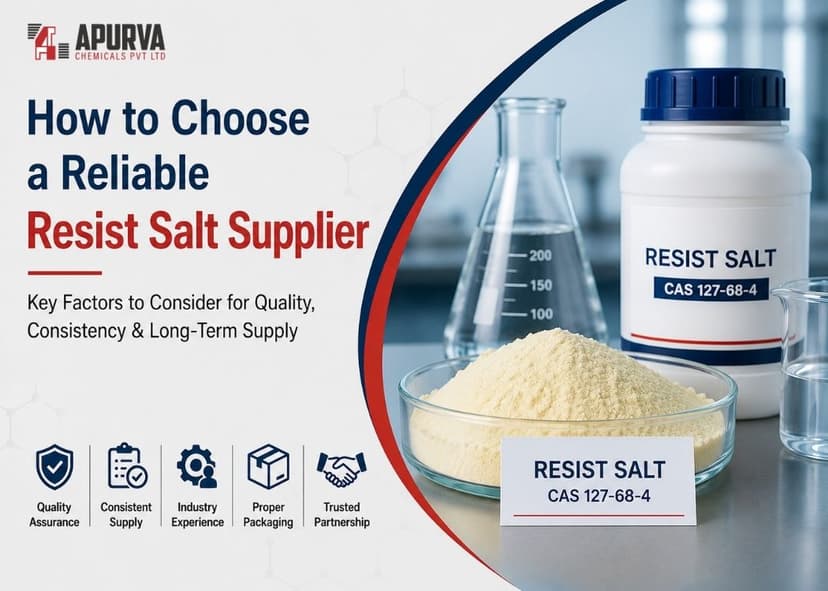
How to Choose a Reliable Resist Salt Supplier
Choosing the right Resist Salt supplier is an important decision for manufacturers that depend on consistent chemical quality, reliable supply, and accurate specifications. A supplier may offer an attractive price, but price alone does not determine whether a chemical supplier is suitable for long-term industrial requirements.
For buyers sourcing Resist Salt in bulk, factors such as product purity, batch consistency, technical documentation, packaging, production capabilities, supply reliability, and technical support should be evaluated before placing an order.
This guide explains the key factors to consider when selecting a reliable Resist Salt supplier in India and how buyers can assess a supplier before starting a long-term business relationship.
Why Choosing the Right Resist Salt Supplier Matters
The quality of an industrial chemical can directly affect downstream manufacturing processes. Variations between batches may create difficulties in production, especially when a chemical is used repeatedly in a controlled formulation or manufacturing process.
A reliable Resist Salt chemical supplier should therefore provide more than just the material. Buyers should expect clear specifications, consistent quality, appropriate packaging, documentation, and dependable communication.
A reliable supplier can help businesses reduce:
Quality-related production issues
Batch-to-batch variations
Procurement delays
Documentation problems
Unexpected supply interruptions
Additional testing and inspection requirements
7 Factors to Consider When Choosing a Resist Salt Supplier
1. Check Product Quality and Specifications
The first step is to understand whether the supplier can consistently meet your required product specifications.
Ask for relevant technical information such as:
Product name
CAS number
Purity
Appearance
Molecular information, where applicable
Application suitability
Storage requirements
Packaging specifications
For CAS 127-68-4, buyers should ensure that the supplier clearly identifies the material and provides specifications relevant to the intended application.
A supplier that can communicate product specifications clearly demonstrates better control over its product and quality process.
2. Evaluate Batch-to-Batch Consistency
For industrial buyers, consistency can be just as important as the initial product quality.
If one batch performs differently from another, manufacturers may need to adjust their production process or carry out additional testing.
Before selecting a Resist Salt supplier, ask about:
Batch testing procedures
Quality control practices
Specification control
Sampling procedures
Certificate of Analysis availability
A supplier should have a systematic approach to maintaining consistent product quality.
3. Verify Manufacturing and Supply Capabilities
There is an important difference between finding a supplier and finding a supplier capable of supporting your long-term requirements.
If you regularly purchase Resist Salt in bulk, evaluate whether the supplier has suitable manufacturing or sourcing capabilities to handle your expected volumes.
Consider:
Production capacity
Regular availability
Bulk order capability
Lead times
Packaging options
Order scheduling
Ability to support repeat requirements
For long-term procurement, supply reliability can be more valuable than a small difference in quoted price.
4. Ask for Technical and Quality Documents
A professional Resist Salt chemical supplier should be able to provide appropriate product documentation based on the buyer's requirements.
Depending on the transaction and application, buyers may request documents such as:
Technical Data Sheet (TDS)
Safety Data Sheet (SDS)
Certificate of Analysis (COA)
Product specifications
Packaging information
Reviewing these documents before purchasing can help procurement and technical teams determine whether the product is suitable for their application.
5. Assess Packaging and Handling
Packaging becomes particularly important when purchasing chemicals in bulk.
Ask the supplier about:
Available pack sizes
Packaging material
Labeling
Batch identification
Storage conditions
Handling recommendations
The packaging should be appropriate for the product and the expected transportation and storage conditions.
6. Consider the Supplier's Industry Experience
Experience in chemical manufacturing or supply can be a useful indicator when evaluating a supplier.
However, buyers should look beyond the number of years in business. Consider whether the supplier understands:
Industrial applications
Quality requirements
Documentation needs
Bulk procurement
Export requirements
Technical specifications
A knowledgeable supplier can often respond more effectively when buyers have application-specific or technical questions.
7. Compare Suppliers on More Than Price
Price is naturally important, but it should not be the only factor in supplier selection.
When comparing a Resist Salt supplier in India, consider the complete value offered:
Factor | What to Evaluate |
Product Quality | Purity and consistency |
Specifications | Clear and defined parameters |
Documentation | TDS, SDS, COA and other required documents |
Supply | Availability and lead time |
Packaging | Suitable bulk and standard options |
Technical Support | Response to product-related questions |
Communication | Clear quotation and order information |
Experience | Relevant chemical industry knowledge |
Price | Competitive total procurement cost |
A supplier offering a slightly lower price may not necessarily provide the best overall value if quality or supply reliability is inconsistent.
Why Choose Apurva Chemicals for Resist Salt?
Apurva Chemicals is an Indian manufacturer and exporter of dye intermediates and organic chemical intermediates.
When evaluating a Resist Salt supplier India, buyers can consider Apurva Chemicals for requirements where product quality, technical information, consistent supply, and professional communication are important.
Our approach focuses on understanding customer requirements and supporting industrial buyers with relevant product information and supply assistance.
For buyers looking for Resist Salt in bulk, discussing the required quantity, specifications, packaging, application, and delivery requirements with the supplier is the best way to determine suitability.
Questions to Ask Before Selecting a Resist Salt Supplier
Before placing an order, buyers should consider asking:
What is the CAS number of the product?
What specifications and purity can you provide?
Can you provide a COA with the supplied batch?
What packaging options are available?
Can you support bulk requirements?
What is the expected lead time?
Can you provide TDS and SDS?
Do you support export requirements?
How do you maintain batch consistency?
Clear answers to these questions can make supplier evaluation much easier.
Conclusion
Choosing a reliable Resist Salt supplier requires more than comparing quotations. Buyers should evaluate product quality, specifications, batch consistency, documentation, packaging, supply capability, technical support, and industry experience.
For companies sourcing Resist Salt in bulk, selecting a supplier capable of meeting both current and future requirements can help create a more dependable procurement process.
Apurva Chemicals supports industrial buyers looking for Resist Salt and other dye intermediates from India. To discuss your requirements, contact our team with the required quantity, specifications, packaging preferences, and delivery details.
Looking for a Reliable Resist Salt Supplier?
Need Resist Salt (CAS 127-68-4) for your industrial or bulk requirements?
Apurva Chemicals supplies quality dye intermediates with product specifications and technical support for industrial buyers.
Get in touch with Apurva Chemicals today to discuss your Resist Salt requirement, quantity, packaging, and delivery needs.
→ Request a Quote for Resist Salt