Understanding Reducing Agents in Textile Dyeing: Why Resist Salt Matters
If you've spent any time on a dye floor, you already know the frustration: two batches, same recipe, same operator, same machine - and yet the shade comes out slightly different. Nine times out of ten, the culprit isn't the dye itself. It's what's happening chemically around the dye during processing, especially unwanted oxidation. This is exactly where reducing agents in textile dyeing step in, and why a compound like Resist Salt (CAS 127-68-4) has quietly become indispensable in dyehouses across India and beyond.
At Apurva Chemicals, we manufacture and supply Resist Salt to textile processors who need predictable, repeatable dyeing outcomes - not guesswork. In this post, we'll break down what reducing agents actually do, why oxidation is such a persistent problem in dyeing, and how Resist Salt specifically solves it.
What Does a Reducing Agent Do in Dyeing?
In simple terms, a reducing agent prevents or reverses oxidation reactions during a chemical process. In textile dyeing, oxidation is often the enemy. When dye molecules or intermediates are exposed to oxygen (or oxidizing conditions) at the wrong stage of processing, they can degrade, change color, or bond unevenly to the fabric. The result: patchy shades, dull colors, or dye that simply doesn't perform the way it's supposed to.
Reducing agents counteract this by controlling the redox environment of the dye bath. They essentially "hold back" oxidation until the dye has properly penetrated and fixed onto the fiber. Without this control, even a well-formulated dye recipe can produce inconsistent, commercially unacceptable results.
This is the core function of resist salt in textile printing and dyeing - it manages that delicate chemical balance so the rest of the process can behave predictably.
What Is Resist Salt Used For?
Resist Salt, chemically known as Sodium 3-Nitrobenzenesulfonate (also called Sodium m-Nitrobenzenesulfonate or Meta Nitrobenzene Sulphonic Acid), is a dye intermediate and process-control agent used extensively in:
Vat dye reduction and printing - helping regulate the reduction of vat dyes so they develop proper, consistent shades.
Sulphur dye dyeing - where oxidation control is critical to avoid tendering (fiber damage) and shade drift.
Cotton and yarn dyeing - maintaining color uniformity across large production lots.
Textile printing - supporting resist and discharge printing styles where controlled oxidation is part of the design process.
In practical terms, Resist Salt for vat dye printing is used because it slows down premature oxidation of the leuco (reduced) form of the dye, giving printers a workable window to apply and fix the color accurately before it oxidizes into its final, insoluble state.
Why Oxidation Control in Textile Dyeing Is Such a Big Deal
Ask any production manager what keeps them up at night, and "batch rejection" is usually near the top of the list. Uncontrolled oxidation during dyeing doesn't just affect color - it has a ripple effect across the entire operation:
Inconsistent shades mean re-dyeing, which burns time, water, energy, and dye.
Fabric damage from aggressive or poorly timed oxidation can weaken fibers, especially with sulphur and vat dyes.
Rejected lots translate directly into lost margin and, worse, damaged client trust.
Compliance and export issues arise when shade consistency fails to meet buyer specifications, especially for international textile exporters.
This is why textile dyeing auxiliaries like Resist Salt aren't a "nice to have" - they're a working safeguard against some of the most common and costly failure points in wet processing.
How Resist Salt Prevents Oxidation: The Practical Side
So how does Resist Salt prevent oxidation in real production conditions? Without getting too deep into reaction mechanisms, here's the practical takeaway: Resist Salt acts on the redox potential of the dye bath, helping stabilize the reduced (leuco) form of certain dyes just long enough for even penetration and fixation to occur. Once the fabric has absorbed the dye properly, the oxidation process can proceed in a controlled, uniform way - rather than happening too fast, too slow, or unevenly across the fabric.
This controlled timing is what separates a clean, consistent dye lot from one riddled with tonal variation.
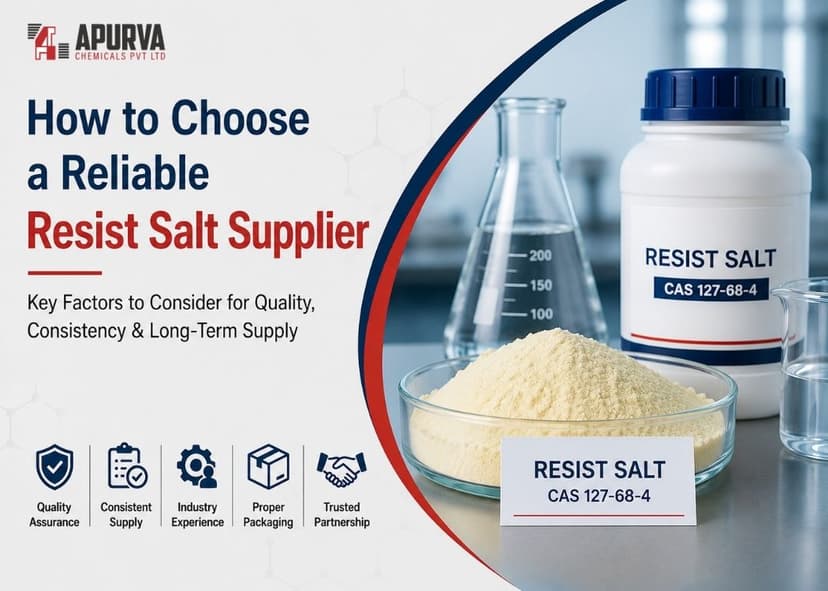
From a technical standpoint, Resist Salt (CAS 127-68-4) has the molecular formula C₆H₄NNaO₅S and a molecular weight of approximately 226.15 g/mol. It's typically supplied as an off-white to light yellow powder or granules, commonly available in 96% and 80% purity grades, with customized grades available depending on application requirements. At Apurva Chemicals, it's packed in 25 kg HDPE bags, with bulk packaging options for larger textile processing units and exporters.
Is Resist Salt Safe for Textile Processing?
This is a fair and common question from processors evaluating a new supplier. Like most industrial dye intermediates, Resist Salt should be handled according to standard chemical safety protocols - proper storage, protective equipment during handling, and adherence to the guidelines outlined in the Material Safety Data Sheet (MSDS). When sourced from a quality-controlled manufacturer and used as per recommended dosages and process conditions, Resist Salt is a well-established, widely used auxiliary in commercial textile dyeing and has been for decades. Always request the MSDS and COA (Certificate of Analysis) from your supplier before scaling up usage - a practice we always encourage, and one we readily support for every batch we dispatch.
What Is the Difference Between Resist Salt and a General Reducing Agent?
It's worth clarifying this, since the terms often get used loosely. "Reducing agent" is a broad chemical category - it refers to any substance that facilitates a reduction reaction. Resist Salt is a specific dye intermediate that functions within this broader category, but its role is more nuanced: it's used specifically to manage and delay oxidation at controlled points in the dyeing or printing process, rather than acting as a general-purpose reducer throughout.
In other words, Resist Salt operates within the reducing agent family, but it plays a more precise role than a generic reducing agent would in vat and sulphur dye applications.
Choosing the Right Resist Salt Supplier
If oxidation control is central to your dyeing consistency, then your choice of Resist Salt supplier matters just as much as your dye formulation. Here's what textile processors should look for:
Consistent purity (96% or as per your process specification) batch after batch.
Documentation support - MSDS, COA, and specification sheets provided without friction.
Reliable supply and lead times, especially for processors running continuous production.
Manufacturing traceability - knowing your Resist Salt comes from a quality-controlled facility, not an unverified trader.
Technical support for dosage guidance and troubleshooting shade inconsistency issues.
As a Resist Salt manufacturer in India with over three decades of experience in dye intermediates, Apurva Chemicals works directly with textile dyeing units, printing facilities, and exporters who need dependable oxidation control at scale. Our quality control laboratory and R&D team ensure that every batch meets the specifications your process depends on - because in textile dyeing, "close enough" isn't good enough.
Final Thoughts
Reducing agents may not be the most glamorous part of the dyeing process, but they're often the quiet difference between a consistent, sellable lot and a costly rework. Resist Salt, in particular, plays a precise and proven role in controlling oxidation during vat and sulphur dyeing, printing, and related applications - helping processors protect both their fabric quality and their bottom line.
If you're evaluating a new Resist Salt supplier or want to discuss purity grades, packaging, or bulk pricing for your production needs, Apurva Chemicals is here to help. Reach out for a quotation, request our MSDS and COA, or speak with our technical team about your specific dyeing application.