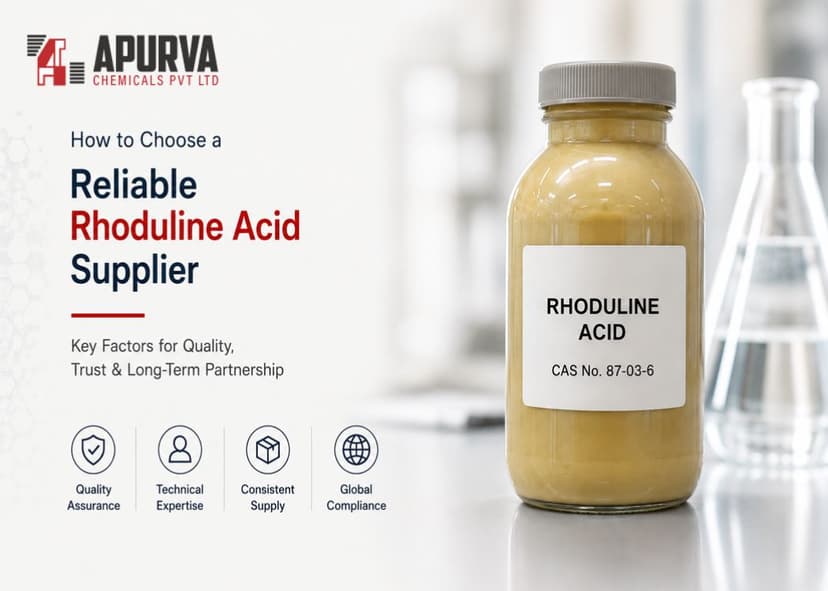
How to Choose a Reliable Rhoduline Acid Supplier
Choosing a Rhoduline Acid Supplier is an important procurement decision for dye manufacturers, pigment producers, textile chemical companies, specialty chemical manufacturers, distributors, and industrial buyers. When a chemical intermediate is used repeatedly in production, the supplier's reliability can directly affect purchasing continuity, quality control, production planning, and delivery schedules.
For buyers evaluating a Rhoduline Acid Supplier in India, the right approach is to look beyond the quoted price. Product specifications, quality consistency, manufacturing capability, documentation, packaging, supply capacity, and export support should all be evaluated before finalizing a supplier.
This guide explains the key factors industrial buyers should consider when sourcing Rhoduline Acid (CAS 87-03-6) for regular, bulk, or export requirements.
Why Choosing the Right Rhoduline Acid Supplier Matters
For industrial buyers, supplier selection is closely connected with production reliability.
An inconsistent supply chain can create problems such as:
Delays in scheduled production
Difficulty maintaining raw-material inventory
Variation between purchased batches
Additional quality-control work
Unplanned procurement costs
Delays in export or customer deliveries
A reliable supplier should therefore be evaluated on product quality and supply capability together.
The objective is not simply to find the lowest-cost Rhoduline Acid. It is to identify a supplier capable of consistently meeting your technical and commercial requirements.
8 Factors to Consider When Choosing a Rhoduline Acid Supplier
1. Confirm the Correct Chemical Identity
Start by confirming that the supplier is offering the required material.
For Rhoduline Acid, verify:
Product name
CAS number: 87-03-6
Chemical specification
Required grade
Physical form
Customer-specific requirements, if applicable
This basic verification can prevent purchasing errors, particularly when chemical names or trade names vary between markets.
2. Evaluate Product Quality
Quality should be one of the first criteria when comparing suppliers.
Ask the supplier for the applicable product specification and understand which parameters are controlled. If your manufacturing process has defined acceptance criteria, share those requirements before placing the order.
A supplier should be able to clearly explain the quality parameters it supplies rather than relying only on a general statement such as "high quality."
3. Check Batch-to-Batch Consistency
For recurring industrial purchases, one acceptable batch is not enough.
Ask how the supplier maintains consistency between production batches and whether quality documentation is available for shipments.
Batch consistency is particularly important when your production process has been optimized around a specific raw-material specification.
4. Understand the Manufacturing Capability
One important question is whether the company actually manufactures the chemical or primarily trades and resells it.
A manufacturer may have greater direct control over:
Production processes
Quality checks
Manufacturing planning
Batch management
Production scheduling
This can be valuable when you require regular or bulk quantities.
For procurement teams, understanding the supplier's role, manufacturer, supplier, distributor, or exporter, helps determine how the supply chain is structured.
5. Review Quality-Control and Technical Documentation
Before purchasing, ask what documentation accompanies the material.
Depending on your requirements, this may include:
Certificate of Analysis (COA)
Safety Data Sheet (SDS/MSDS)
Technical Data Sheet (TDS)
Product specification
Packing details
Applicable shipping documentation
Documentation should be reviewed before the commercial order is finalized, especially when the material is being purchased for an established industrial process.
6. Check Packaging Options
Packaging is an important consideration for bulk chemical procurement because it affects storage, handling, transportation, and shipment planning.
Apurva Chemicals states that its standard packaging sizes range from 20–50 kg, depending on customer specifications, while jumbo bags range from 350–700 kg. The company also states that bags are palletized on fumigated wooden pallets.
For your specific Rhoduline Acid requirement, confirm:
Package size
Packaging material
Labeling
Palletization
Bulk-packaging requirements
Export packaging requirements
7. Assess Supply Capacity and Lead Time
If Rhoduline Acid is a regular production input, supplier capacity matters.
Before entering into a recurring supply arrangement, discuss:
Required monthly or annual quantity
Minimum order quantity
Production lead time
Stock availability
Repeat-order capacity
Dispatch timelines
Emergency or additional quantity requirements
A supplier that understands your purchasing schedule can help make procurement more predictable.
8. Evaluate Export Experience
International buyers should evaluate more than product quality.
A suitable Rhoduline Acid Exporter should be able to coordinate the commercial and logistical aspects of international supply, including appropriate documentation, packaging, shipment planning, and communication.
For exporters, clarity is especially important regarding:
Product documentation
Packing specifications
Shipping terms
Shipment schedules
Destination requirements
Export documentation
Manufacturer vs Supplier vs Exporter: What Should Buyers Choose?
The terms manufacturer, supplier, and exporter describe different parts of the supply chain.
Manufacturer: Produces the chemical and has direct involvement in its manufacturing processes.
Supplier: Supplies the product to the buyer and may manufacture it directly or source it from another producer.
Exporter: Handles international supply and associated export processes.
For industrial buyers with recurring requirements, working with a company that combines manufacturing, supply, and export capabilities can simplify sourcing and communication.
However, buyers should still verify the specific product capability, documentation, and commercial terms for each order.
How to Source Rhoduline Acid in Bulk
If you are looking for a Rhoduline Acid Bulk Supplier, prepare your purchasing requirement before contacting suppliers.
A useful RFQ should include:
Product: Rhoduline Acid
CAS: 87-03-6
Required quantity: Specify the immediate and recurring requirement
Specification: Include your required technical parameters
Packaging: State preferred package size or bulk format
Delivery location: Domestic or international destination
Documentation: Specify COA, SDS/MSDS, TDS, or other required documents
Delivery schedule: State your required timeline
Application: Mention the intended industrial use when relevant
Providing this information allows suppliers to respond with a quotation that is more closely aligned with your actual requirement.
Why Choose Apurva Chemicals?
Rhoduline Acid (CAS 87-03-6) is listed within Apurva Chemicals' dye-intermediate portfolio. The company's Rhoduline Acid product page provides product identification and technical information for buyers evaluating the material.
For industrial procurement, buyers can discuss product requirements, quantity, packaging, documentation, and delivery requirements directly with Apurva Chemicals.
Common Mistakes Buyers Should Avoid
When selecting a Rhoduline Acid supplier, avoid these common procurement mistakes:
Choosing a supplier solely because of the lowest quotation
Not confirming the CAS number
Purchasing without reviewing the specification
Failing to evaluate batch consistency
Not requesting appropriate quality documentation
Ignoring packaging requirements
Not checking the supplier's manufacturing capability
Failing to discuss lead times for repeat orders
Assuming every supplier can handle bulk quantities
Not confirming export documentation for international shipments
Changing suppliers without evaluating the impact on your production process
The best supplier decision should consider technical suitability, quality, reliability, commercial terms, and long-term supply capability together.
Conclusion
Choosing a reliable Rhoduline Acid Supplier requires a structured evaluation rather than simply comparing prices. Industrial buyers should verify the chemical identity and specification, assess product quality and batch consistency, understand manufacturing capabilities, review documentation, confirm packaging, and evaluate supply and export capacity.
For companies searching for a Rhoduline Acid Supplier in India, these factors can help identify a sourcing partner capable of supporting both immediate requirements and recurring industrial procurement.
Apurva Chemicals supplies Rhoduline Acid (CAS 87-03-6) as part of its dye-intermediate portfolio. For product information, bulk requirements, technical documentation, packaging requirements, or export inquiries, contact Apurva Chemicals to discuss your specific requirement.
Get Reliable Rhoduline Acid Supply from Apurva Chemicals
Looking for a reliable Rhoduline Acid Supplier in India for bulk, recurring, or export requirements? Apurva Chemicals offers Rhoduline Acid (CAS 87-03-6) along with a range of dye intermediates and specialty chemicals.
Whether you need product information, technical documentation, bulk quantities, customized packaging, or export supply support, our team can discuss your specific requirements.
Contact Apurva Chemicals today to enquire about Rhoduline Acid (CAS 87-03-6), pricing, availability, bulk supply, and export requirements.