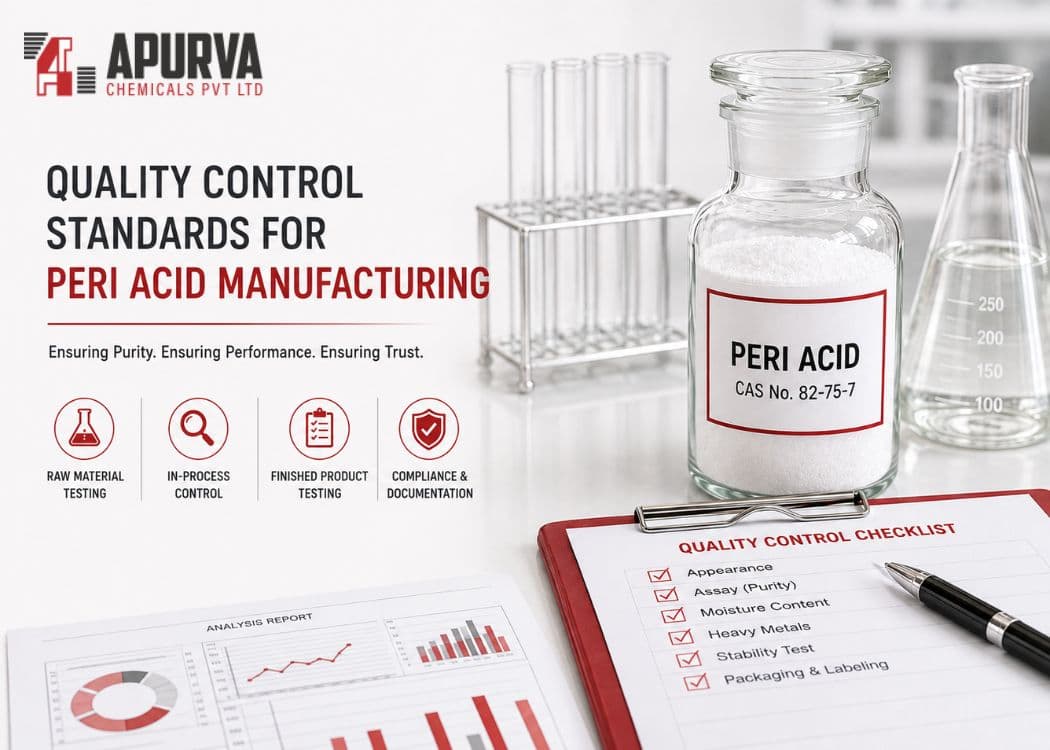
Quality Control Standards for Peri Acid Manufacturing
In dye-intermediate manufacturing, consistent raw-material quality is essential because even relatively small variations in an intermediate can affect downstream reactions, process yield, shade development, and final product consistency. This makes Peri Acid manufacturing more than a production exercise,it requires controlled chemistry, analytical testing, documented procedures, and traceability.
Peri Acid, identified by CAS No. 82-75-7, is also known as 8-amino-1-naphthalenesulfonic acid or 1-naphthylamine-8-sulfonic acid. PubChem lists its molecular formula as C10H9NO3S and molecular weight as approximately 223.25 g/mol.
As a dye intermediate, Peri Acid is used in chemical synthesis routes for colorants and related intermediates. Therefore, manufacturers need quality systems that control raw materials, reaction conditions, isolation, purification, drying, packaging, and final release.
This article explains the major Peri Acid quality standards, testing considerations, process controls, documentation requirements, and practical supplier-selection criteria.
Why Is Quality Control Important in Peri Acid Manufacturing?
Quality control ensures that every production batch meets its predefined specifications before it is released to a customer.
For Peri Acid, quality control is particularly important because the material may be used in further chemical reactions where purity and isomeric composition can influence downstream processing.
A suitable QC program helps manufacturers control:
Chemical identity
Purity
Moisture and physical characteristics
Relevant impurities
Batch-to-batch consistency
Packaging integrity
Documentation and traceability
A strong quality system also supports customer confidence and helps identify process deviations before they become larger production problems.
What Are the Key Peri Acid Quality Control Parameters?
There is no single universal specification that applies to every Peri Acid application. Buyers and manufacturers should establish specifications according to the intended use, process requirements, applicable regulations, and agreed customer specification.
However, several parameters are commonly important.
1. Chemical Identity
The first requirement is confirming that the material supplied is actually the intended compound.
For CAS 82-75-7, authoritative chemical databases identify the substance as 8-amino-1-naphthalenesulfonic acid.
Depending on the quality system and application, identity may be verified using analytical techniques such as:
Infrared spectroscopy (IR)
Chromatographic comparison
Other validated identification methods
Identity testing helps prevent mix-ups between chemically similar intermediates.
2. Purity
Purity is one of the most important Peri Acid quality standards.
A high-purity material can provide better control over downstream synthesis, while unwanted impurities may affect reaction performance or final colorant characteristics.
The actual acceptance limit should be defined in the product specification rather than assumed from a generic market value.
For example, laboratory-grade commercial material for 8-amino-1-naphthalenesulfonic acid is offered with specifications above 98% by HPLC by some suppliers, demonstrating that analytical purity specifications can be explicitly defined. Industrial grades may use different agreed specifications.
3. Isomer and Related-Impurity Control
For aromatic dye intermediates, controlling related compounds can be important because structurally similar isomers can behave differently in downstream chemistry.
This is especially relevant when Peri Acid is manufactured from processes involving aminonaphthalenesulfonic acid mixtures.
Therefore, an effective QC program should identify relevant impurities and establish appropriate acceptance limits based on the manufacturing route and customer application.
Key principle: purity should not be evaluated only as a single percentage; the impurity profile can also matter.
4. Moisture and Physical Characteristics
Moisture can influence:
Product weight calculations
Storage stability
Material handling
Batch formulation
Downstream reaction charging
Manufacturers may therefore define appropriate moisture or loss-on-drying requirements according to the product specification.
Physical characteristics such as appearance, particle form, and color can also be monitored as part of routine quality inspection.
Chemical references describe Peri Acid as a powder/crystalline material and report color descriptions ranging from light yellow to brown depending on the source and material form.
Because appearance can vary with grade, moisture, particle size, and processing history, it should be treated as a specification parameter rather than a standalone proof of purity.
5. Batch-to-Batch Consistency
A good Peri Acid manufacturing process should produce material with consistent characteristics from one batch to another.
Manufacturers can monitor trends in:
Assay/purity
Moisture
Appearance
Impurity profile
Yield
Process parameters
Trend analysis can help identify gradual changes before they result in an out-of-specification batch.
This is where a documented quality management system becomes important.
ISO 9001:2015 provides a general framework for quality management, including process control, monitoring and measurement, documented information, performance evaluation, and continual improvement.
Importantly, ISO 9001 is a quality-management-system standard, not a specific Peri Acid product specification.
How Does Quality Control Work During Peri Acid Manufacturing?
Effective quality control should cover the complete manufacturing lifecycle rather than relying only on final-product testing.
Step 1: Raw Material Inspection
Incoming raw materials should be verified against approved specifications.
Typical controls may include:
Supplier approval
Certificate verification
Identity testing where required
Quantity verification
Storage-condition checks
Raw materials that fail defined requirements should be quarantined until disposition.
Step 2: Process Control
Manufacturing parameters should be controlled according to the validated or established process.
Depending on the production route, critical process variables may include:
Temperature
Reaction time
pH
Addition rates
Concentration
Agitation
Filtration conditions
Process deviations should be documented and investigated according to the manufacturer's quality procedures.
Step 3: Isolation and Purification
Isolation and purification are important because they influence the final impurity profile.
Filtration, washing, precipitation, crystallization, or other applicable separation operations should be controlled consistently.
The objective is not simply to obtain a product that looks correct, but to achieve the required chemical and physical specification.
Step 4: Drying and Final Processing
Drying conditions should be controlled to achieve the required moisture and physical characteristics without adversely affecting product quality.
After drying, the material may undergo:
Milling
Sieving
Homogenization
Final blending, where applicable
Any such operation should be controlled and documented.
Step 5: Final Quality Testing
Before release, the finished batch should be tested against the approved specification.
A typical release framework may include:
Quality Area | Example Control |
Identity | Validated identification test |
Assay/Purity | Appropriate analytical method |
Related impurities | Chromatographic or validated method |
Moisture | Moisture/LOD testing |
Appearance | Visual inspection |
Packaging | Container and label inspection |
Documentation | COA and batch records |
The exact tests and limits should be established based on the product grade and customer requirements.
What Documents Should a Peri Acid Manufacturer Provide?
For industrial procurement, documentation is an important part of supplier qualification.
Depending on the transaction and destination market, relevant documentation may include:
Certificate of Analysis (COA)
Safety Data Sheet (SDS)
Technical Data Sheet (TDS)
Batch or lot number
Manufacturing date or relevant traceability information
Packaging details
Regulatory documentation where applicable
Transport documentation where required
The COA should correspond to the actual batch supplied rather than being treated as a generic product sheet.
Peri Acid Quality Control Checklist
Before approving a supplier, procurement and technical teams can use this checklist:
CAS number verified as 82-75-7
Chemical identity confirmed
Approved product specification available
Purity/assay requirement defined
Relevant impurities identified
Moisture requirement established
Appearance specification defined
Appropriate test methods documented
Batch-specific COA available
SDS available and current
Lot traceability maintained
Packaging requirements confirmed
Sample/trial evaluation completed
Supplier quality system assessed
Conclusion
Effective Peri Acid manufacturing depends on controlled chemistry, appropriate purification, validated or established analytical testing, batch traceability, and documented quality procedures. Because Peri Acid CAS 82-75-7 is used as a dye intermediate, maintaining consistent chemical characteristics is important for reliable downstream processing.
The most effective Peri Acid quality control approach combines raw-material inspection, process monitoring, impurity control, final-product testing, documentation, and supplier qualification.
For buyers, the right approach is to evaluate more than the quoted price. Chemical identity, purity, impurity profile, batch consistency, documentation, packaging, manufacturing capability, and technical support should all form part of the supplier assessment.
Looking for a Reliable Peri Acid Supplier?
If you are sourcing Peri Acid (CAS 82-75-7) for dye-intermediate or specialty chemical applications, work with a supplier that can provide clear specifications, batch documentation, consistent quality, and dependable supply.
Contact Apurva Chemicals to discuss your Peri Acid requirements, request product specifications, or enquire about industrial supply.