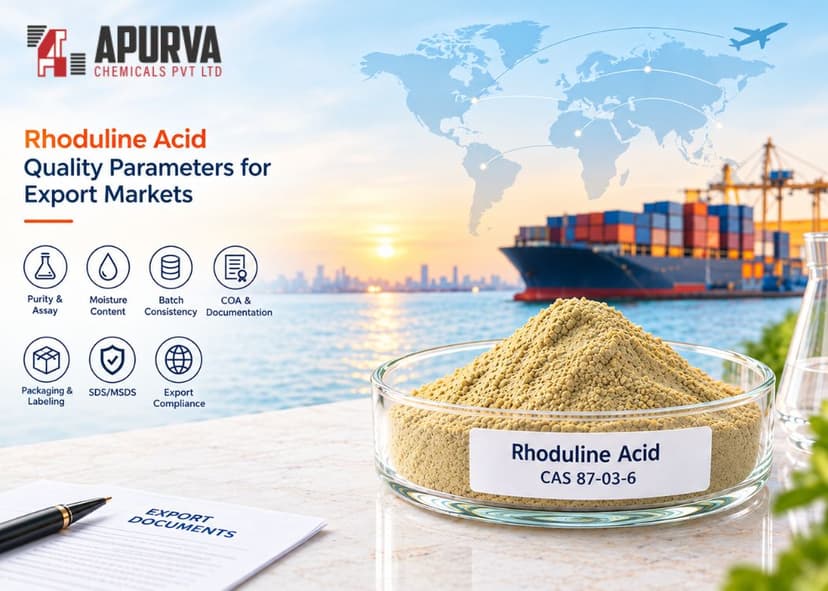
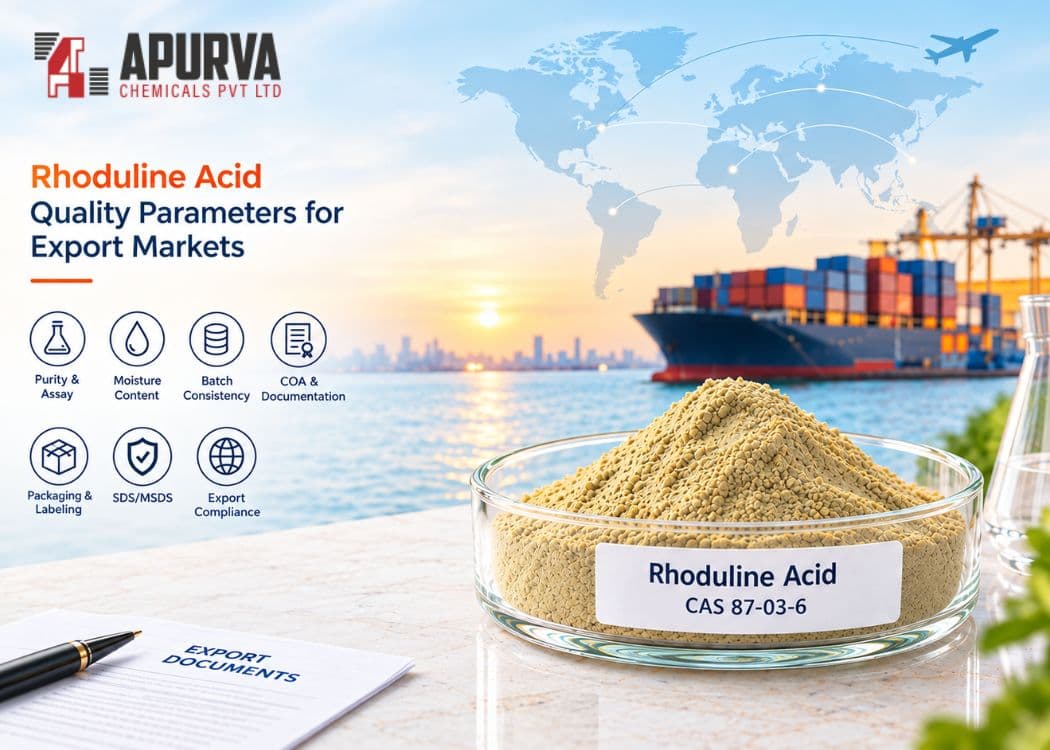
Rhoduline Acid Quality Parameters for Export Markets
International buyers of dye intermediates and specialty chemicals increasingly evaluate suppliers on more than price and availability. Consistent chemical quality, accurate documentation, batch-to-batch uniformity, packaging, and export readiness all play an important role in supplier selection. This is particularly relevant for products such as Rhoduline Acid, which is used as a specialized intermediate in chemical and colorant manufacturing.
For companies sourcing Rhoduline Acid export quality, understanding the important quality parameters helps procurement teams compare specifications and reduce quality-related risks. At the same time, buyers who source related dye intermediates such as 1,6-Cleve's Acid often apply similar expectations for identity, purity, appearance, documentation, and consistency.
Apurva Chemicals supplies dye intermediates from Vapi, Gujarat, India, with a focus on consistent specifications, technical documentation, and reliable industrial supply.
Why Export Quality Matters for Rhoduline Acid
Export customers may operate under different technical specifications, regulatory requirements, packaging standards, and quality-control procedures. A batch that meets one buyer's internal specification may not automatically meet another customer's requirements.
For this reason, an experienced Rhoduline Acid exporter in India should establish clear specifications before dispatch.
Important export considerations commonly include:
Correct chemical identity
CAS number verification
Appearance and physical form
Purity or assay
Moisture or loss on drying, where applicable
Insoluble matter
pH or solution characteristics, where specified
Batch consistency
Packaging integrity
Certificate of Analysis (COA)
Safety Data Sheet (SDS/MSDS)
Certificate of Origin (COO), where required
Export documentation and labeling
The exact acceptance limits should always be agreed between the supplier and buyer rather than assuming one universal specification applies to every market.
Key Rhoduline Acid Quality Parameters
1. Chemical Identity
The first quality checkpoint is confirming that the supplied material corresponds to the required chemical.
For Rhoduline Acid, buyers should verify:
Product: Rhoduline Acid
CAS: 87-03-6
CAS identification is especially important during international procurement because similar chemical names, synonyms, or related intermediates can otherwise create confusion.
A reliable supplier should ensure that product documentation, labels, specifications, and COA refer to the same chemical identity.
2. Purity and Assay
Purity is one of the most important parameters when purchasing dye intermediates for industrial synthesis.
A consistent assay helps manufacturers maintain predictable reaction conditions and reduce variation between production batches. Buyers should therefore specify the required purity level before placing an order.
Instead of relying only on a general statement such as "high purity," procurement teams should request an agreed numerical specification and corresponding test method.
The COA supplied with each batch should demonstrate whether the material meets the agreed specification.
3. Appearance
Physical appearance is another practical quality-control parameter.
Depending on the manufacturing process and agreed specification, buyers may define acceptable characteristics such as:
Color
Powder or solid form
Uniformity
Presence of visible foreign particles
Caking or agglomeration
Appearance alone does not establish chemical purity, but significant changes between batches can indicate differences in processing, moisture exposure, contamination, or storage conditions.
Therefore, visual inspection should be considered alongside analytical testing.
4. Moisture and Physical Condition
Moisture can influence the handling, storage, weighing, and processing of chemical intermediates.
Where moisture or loss-on-drying is included in the buyer's specification, the supplier should test and report the parameter using an agreed method.
Proper packaging also becomes important because exposure to humidity during transportation can affect the physical condition of powdered materials.
For export shipments, moisture-resistant packaging and suitable storage instructions can help maintain product condition throughout transportation.
5. Batch-to-Batch Consistency
International manufacturers often purchase chemical intermediates repeatedly. Therefore, consistency from one batch to another can be just as important as the specification of an individual batch.
A strong quality system should monitor parameters such as:
Appearance
Purity
Moisture
Relevant chemical characteristics
Impurity profile, when specified
Physical condition
Consistent batch quality helps downstream manufacturers maintain stable production processes and reduces the need for additional troubleshooting.
This principle also applies to other dye intermediates. For example, 1,6-Cleve's Acid is identified as CAS 119-79-9, with molecular formula C10H9NO3S and molecular weight approximately 223.25 g/mol. Apurva Chemicals lists its industrial specification with purity of ≥94–97% and appearance as gray-red powder.
6. Certificate of Analysis (COA)
A COA is an important document for international chemical buyers.
For each shipment, the COA should provide relevant batch information and test results against the agreed specification.
Depending on the customer's requirements, it may include:
Product name
Batch number
Manufacturing or testing date
Appearance
Purity/assay
Other agreed technical parameters
Test results
Specification limits
Quality-control approval
The COA gives the buyer a documented basis for confirming that the supplied batch meets the agreed requirements.
7. SDS/MSDS and Export Documentation
Chemical exports require appropriate documentation to support safe handling, transportation, storage, and regulatory compliance.
An SDS/MSDS provides important information about hazards, handling, storage, personal protective measures, and emergency procedures.
International buyers may also request:
Certificate of Origin
Commercial invoice
Packing list
Technical specification
COA
SDS
Shipping documents
Other country- or customer-specific documents
Documentation requirements can vary according to destination country, transport mode, and buyer requirements. Therefore, export documentation should be confirmed before shipment.
8. Packaging and Labeling
Packaging plays an important role in preserving chemical quality during international transportation.
For powdered dye intermediates, packaging should protect the product from moisture, contamination, physical damage, and unsuitable storage conditions.
Export labels should clearly identify relevant information such as:
Product name
CAS number
Batch number
Net weight
Manufacturer or supplier information
Handling/storage information where required
Packaging specifications should be agreed according to the customer's order size, destination, transport conditions, and regulatory requirements.
How Buyers Can Evaluate Rhoduline Acid Export Quality
A practical procurement evaluation can follow five steps:
Step 1: Confirm Product Identity
Verify the product name and CAS number before requesting a quotation.
Step 2: Share Your Technical Specification
Provide the required purity, appearance, moisture limits, testing requirements, and other parameters.
Step 3: Request Technical Documents
Ask for the product specification, COA, and SDS/MSDS before finalizing the purchase.
Step 4: Evaluate Batch Consistency
For recurring orders, compare COAs from multiple batches rather than evaluating only one shipment.
Step 5: Confirm Export Requirements
Discuss packaging, labeling, documentation, shipping terms, destination requirements, and expected lead time.
This approach can help international buyers establish a more transparent and reliable sourcing process.
Rhoduline Acid Exporter in India
India is an important sourcing base for dye intermediates and specialty chemicals, and suppliers serving international customers need to combine manufacturing capability with quality control and export support.
Apurva Chemicals operates from Vapi, Gujarat, and its published product portfolio includes Rhoduline Acid (CAS 87-03-6) along with other dye intermediates such as 1,6-Cleve's Acid.
For international buyers, working with a Rhoduline Acid exporter in India can provide access to technical documentation, product specifications, packaging options, and export-oriented supply support.
Apurva Chemicals focuses on supplying dye intermediates for industrial applications with attention to product specifications and consistent supply.
Conclusion
Quality evaluation is an essential part of sourcing Rhoduline Acid for international markets. Parameters such as chemical identity, purity, appearance, moisture, batch consistency, documentation, packaging, and labeling should be clearly defined before shipment.
For industrial procurement teams, the goal should be more than finding a supplier offering a competitive quotation. A dependable supply program requires consistent specifications, transparent quality documentation, appropriate packaging, and clear communication throughout the order process.
Whether sourcing Rhoduline Acid or related dye intermediates such as 1,6-Cleve's Acid, buyers should confirm the exact CAS number and technical requirements before placing an order.
Apurva Chemicals supports industrial and international customers with dye intermediate supply from Vapi, Gujarat, with a focus on specifications, documentation, and reliable supply.
Looking for Rhoduline Acid (CAS 87-03-6) for your industrial or export requirement? Contact Apurva Chemicals to discuss your required specification, quantity, packaging, and documentation.