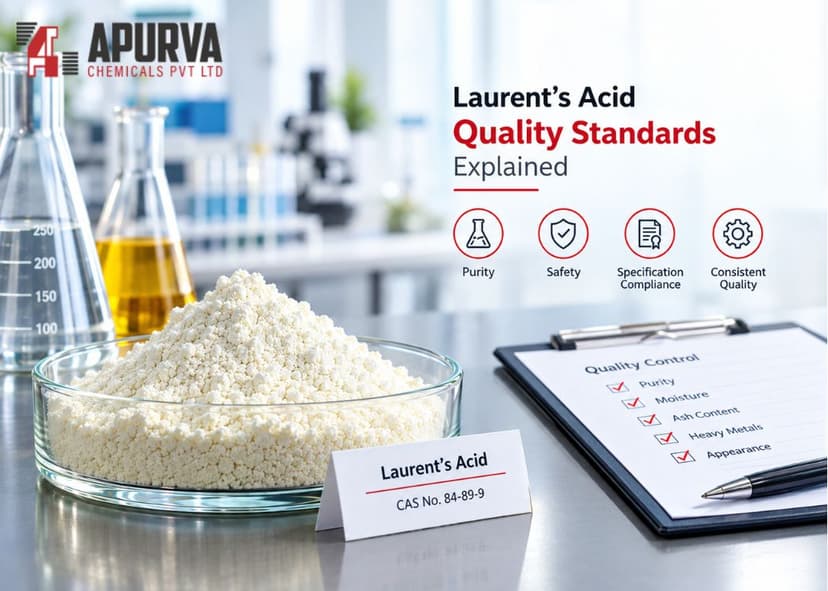
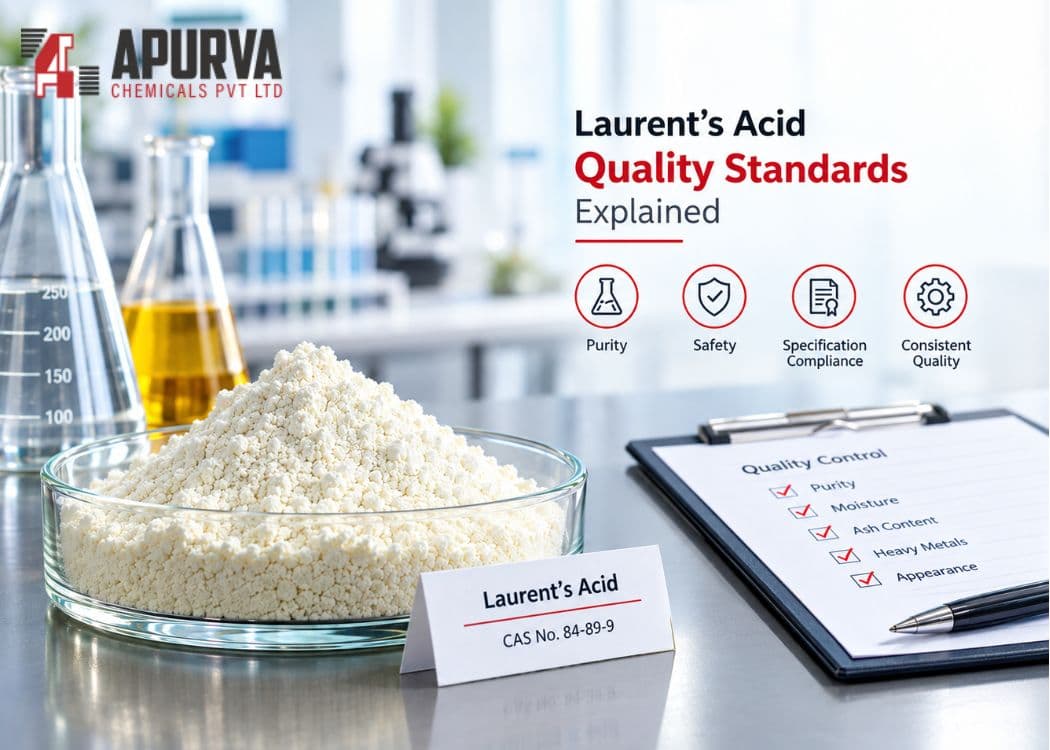
Laurent's Acid Quality Standards Explained
In dye-intermediate manufacturing, consistent raw-material quality is essential for maintaining reliable production, predictable reactions, and uniform finished products. Laurent's Acid is an important aromatic sulfonic acid intermediate used in dye and specialty chemical manufacturing, making its quality particularly relevant to manufacturers that require dependable batch-to-batch performance.
Laurent's Acid is identified as 5-amino-1-naphthalenesulfonic acid, with CAS 84-89-9, molecular formula C10H9NO3S, and molecular weight 223.25 g/mol. It is associated with the manufacture of various dyestuffs and chemical formulations.
For buyers, understanding Laurent's Acid Quality means looking beyond the product name. Appearance, purity, identification, moisture, impurities, packaging, documentation, and batch consistency can all influence whether a material is suitable for a particular manufacturing process.
Why Laurent's Acid Quality Matters
The quality of an intermediate can affect more than the incoming raw-material inspection. It can influence reaction consistency, process control, impurity formation, downstream purification, and the characteristics of the final dye or chemical product.
A consistent Laurent's Acid Purity is particularly important when the material is being used in a controlled synthesis process. Variations in purity or unwanted impurities may change the amount of usable active material entering a reaction and can potentially affect process efficiency.
For manufacturers purchasing Laurent's Acid regularly, quality consistency is therefore an important part of supplier evaluation.
Key Laurent's Acid Quality Parameters
A suitable quality specification should define the characteristics that matter for the buyer's intended application. Typical evaluation areas include the following.
1. Chemical Identity
The first quality requirement is confirming that the supplied material corresponds to the intended chemical.
For Laurent's Acid, the primary identifiers include:
Chemical name: Laurent's Acid
Chemical identity: 5-amino-1-naphthalenesulfonic acid
CAS Number: 84-89-9
Molecular formula: C10H9NO3S
Molecular weight: 223.25 g/mol
These identifiers help purchasing and quality teams verify that the material matches the required intermediate.
2. Purity or Assay
Laurent's Acid Purity is one of the most important commercial specifications. The required assay should be agreed between the buyer and supplier according to the intended application and manufacturing process.
A COA should clearly state the tested purity or assay result and the applicable specification limit. Buyers should compare the reported result with the agreed specification instead of assuming that every supplier's product has the same grade.
For recurring purchases, maintaining a consistent purity range can make production planning and batch qualification easier.
3. Appearance
Appearance is a practical first-level quality check during incoming inspection.
Reference information describes Laurent's Acid as white or pale pink needle-like crystals in pure form, while commercial forms can differ.
A buyer's specification should therefore define the acceptable appearance for the purchased grade. Changes in colour, physical form, or visible contamination can be useful indicators for further investigation, although appearance alone should not be treated as proof of chemical purity.
4. Moisture and Physical Condition
Moisture can be relevant when purchasing hygroscopic or water-associated chemical materials. Excess moisture may affect the actual amount of active material delivered on a weight basis and can influence handling or downstream processing.
Where moisture is relevant to the application, it should be included as a controlled parameter in the product specification and reported through appropriate testing.
5. Impurity Profile
A high-quality intermediate is not defined only by its main assay value. Certain applications may require control of specific organic or inorganic impurities.
The acceptable impurity profile should be established according to the customer's process requirements. For critical applications, buyers may request additional analytical information alongside the standard COA.
This approach helps ensure that Laurent's Acid is evaluated according to actual manufacturing needs rather than a generic checklist.
What Should a Laurent's Acid COA Include?
A Certificate of Analysis (COA) provides documented evidence of the quality testing performed on a specific batch.
For Laurent's Acid, a useful COA may include:
Product name
CAS 84-89-9
Batch or lot number
Manufacturing or test date
Applicable specification
Test parameters
Individual test results
Purity or assay
Appearance
Relevant impurity or moisture results
Packaging information, where applicable
Authorized quality-control approval
The exact parameters should correspond to the agreed product specification and customer requirements.
A batch-specific COA is especially useful for industrial buyers because it provides traceability between the material received and the quality results recorded for that batch.
How to Evaluate Laurent's Acid Quality Before Purchase
Buyers can use a structured evaluation process when selecting a Laurent's Acid supplier.
First, confirm chemical identity. Check the product name, CAS number, formula, and other identifiers against the required material.
Second, review the specification. Make sure the supplier's stated parameters correspond to your manufacturing requirements.
Third, check purity requirements. Confirm the agreed assay or purity range before placing a commercial order.
Fourth, request a COA. Review batch-specific test results rather than relying only on a general product datasheet.
Fifth, evaluate consistency. For repeat purchases, compare COAs from multiple batches to understand whether the material remains within the agreed specification.
Finally, review documentation and packaging. Proper identification, suitable packaging, and supporting documents such as SDS/MSDS and product specifications can simplify receiving, storage, compliance, and internal quality procedures.
Laurent's Acid Quality for Dye Intermediate Manufacturing
Laurent's Acid is used as a dyestuff intermediate, so its quality should be considered in the context of the customer's downstream synthesis. Reference sources identify it as a dyestuff intermediate, while Apurva Chemicals lists Laurent's Acid among its dye-intermediate products.
For manufacturers, the objective is not simply to purchase a material with a particular name. The objective is to obtain a consistent intermediate that meets the agreed specification and performs reliably in the intended process.
This is particularly relevant for manufacturers operating regular production schedules, where unexpected variation in incoming intermediates can create additional quality-control work or process adjustments.
Why Supplier Quality Systems Matter
Supplier capability is another factor to consider when sourcing Laurent's Acid. A supplier with established quality-control procedures can provide greater transparency around testing, batch documentation, and production consistency.
Apurva Chemicals states that it is an ISO 9001:2015 certified manufacturer, supplier, and exporter of dye intermediates and industrial chemicals. The company also describes a specialized quality-control laboratory and an R&D team supporting its manufacturing and quality processes.
For buyers, these capabilities can be considered alongside product specifications, COA documentation, technical support, packaging requirements, and supply requirements when evaluating a chemical supplier.
Laurent's Acid: Quality Checklist for Buyers
Before purchasing Laurent's Acid, buyers can use this simple checklist:
Confirm Laurent's Acid CAS 84-89-9.
Verify the chemical identity and molecular information.
Define the required purity or assay.
Establish acceptable appearance and physical specifications.
Identify any application-specific impurity requirements.
Request a batch-specific COA.
Review SDS/MSDS and product specifications.
Confirm packaging and labelling requirements.
Check batch traceability.
Compare quality consistency across repeat supplies.
This approach provides a more reliable basis for procurement than selecting a product solely on price.
Conclusion
Understanding Laurent's Acid Quality is important for dye and specialty chemical manufacturers that depend on consistent intermediates. Laurent's Acid, CAS 84-89-9, should be evaluated through a combination of chemical identity, purity, appearance, relevant physical and chemical parameters, impurity control, documentation, and batch consistency.
For buyers, the most practical approach is to establish a clear specification before procurement and verify every batch through appropriate quality documentation such as a COA, SDS/MSDS, and product specification sheet.
Apurva Chemicals manufactures, supplies, and exports Laurent's Acid and other dye intermediates from India. Its quality-control laboratory, ISO 9001:2015 certification, and focus on consistent dye-intermediate quality support industrial sourcing requirements.
Source Laurent's Acid from Apurva Chemicals
Apurva Chemicals supplies Laurent's Acid (CAS 84-89-9) for industrial and dye-intermediate applications. Contact the team to discuss your required purity, specification, packaging, quantity, COA, SDS/MSDS, and supply requirements.