
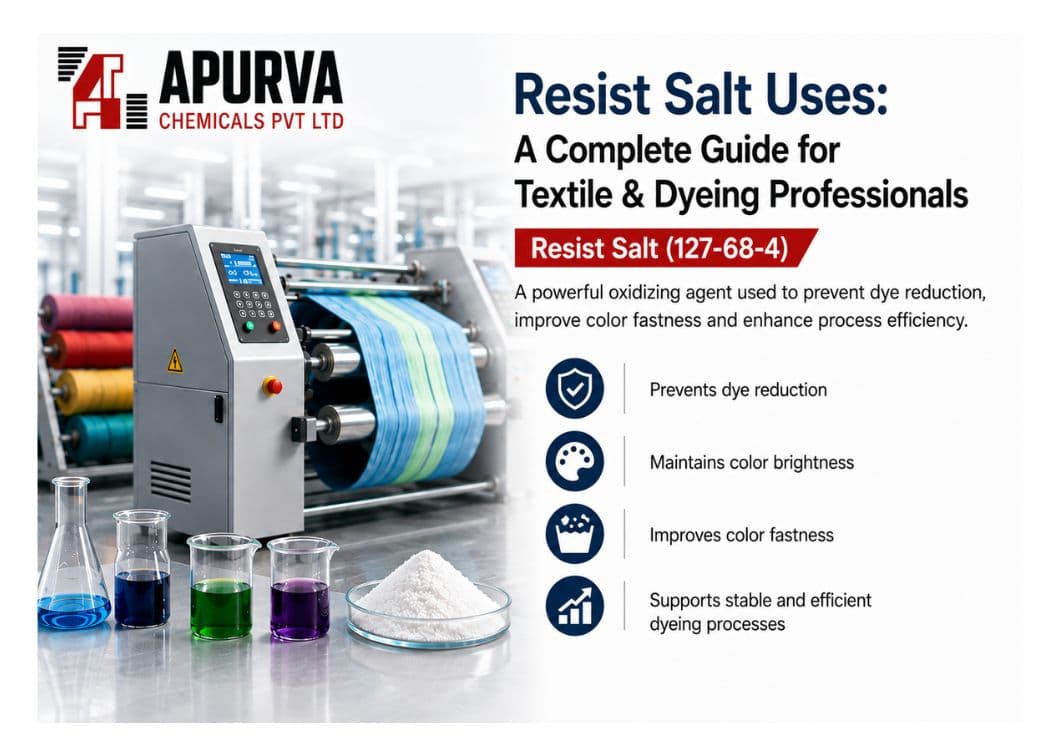
Resist Salt Uses: A Complete Guide for Textile & Dyeing Professionals
In the modern textile industry, maintaining consistent color quality, preventing dye damage, and achieving precise printing results are essential for success. One of the most important chemicals that supports these outcomes is Resist Salt (CAS No. 127-68-4).
This in-depth guide by Apurva Chemicals explains resist salt uses, its role in textile processing, key benefits, and best practices for dyeing professionals. The content is structured to be SEO-friendly, EEAT-compliant, and optimized for AEO, GEO, and LLM readability.
Key Properties of Resist Salt
To understand its importance, here are the core characteristics of resist salt:
Strong oxidizing properties
Excellent water solubility
High thermal stability
Compatible with various dye classes
Helps maintain dye integrity during processing
These features make it a reliable chemical for textile manufacturers and dyeing units.
Resist Salt Uses in Textile Industry
1. Preventing Dye Reduction
One of the most critical resist salt uses is preventing the reduction of dyes, particularly in sulfur and vat dyeing.
During dyeing, reducing agents can alter dye molecules, leading to faded or uneven shades. Resist salt counteracts this by maintaining an oxidizing environment, ensuring vibrant and consistent colors.
2. Textile Printing Enhancement
Resist salt is widely used in textile printing processes to improve pattern clarity and color precision.
Prevents color bleeding
Ensures sharp design outlines
Maintains uniform color distribution
It is especially valuable in resist and discharge printing techniques.
3. Improving Color Fastness
Color durability is essential for textile quality. Resist salt helps enhance resistance to:
Washing
Light exposure
Friction
By stabilizing dye molecules, it ensures that fabrics retain their color over time.
4. Sulfur Dyeing Control
Sulfur dyeing requires a careful balance between reduction and oxidation. Excessive reduction can damage the dye quality.
Resist salt helps by:
Controlling reduction levels
Preventing over-processing
Supporting uniform dye absorption
This results in improved shade depth and consistency.
5. Vat Dyeing Stabilization
Vat dyeing involves complex chemical reactions that require precise control.
Resist Salt (127-68-4) plays a key role in:
Supporting proper oxidation after dyeing
Ensuring even shade development
Reducing patchiness in fabrics
This makes it essential for high-quality textile production.
6. Dye Bath Protection
Another important resist salt use is protecting the dye bath from unwanted chemical reactions.
It helps to:
Maintain chemical stability
Prevent dye degradation
Extend dye bath usability
7. Discharge Printing Applications
In discharge printing, certain areas of dyed fabric are selectively decolorized to create patterns.
Resist salt helps:
Control chemical reactions
Produce clean and defined patterns
Enhance contrast between dyed and discharged areas
This ensures high-quality printing results.
Benefits of Using Resist Salt
Using resist salt in textile processes provides multiple advantages:
Consistent Color Output
Ensures uniform shades across different batches.
Enhanced Fabric Appearance
Improves brightness and clarity of dyed fabrics.
Reduced Material Waste
Minimizes errors and dye loss during processing.
Process Stability
Maintains controlled chemical reactions.
Versatile Applications
Suitable for dyeing, printing, and finishing processes.
Industrial Applications Beyond Textiles
Although primarily used in textiles, Resist Salt (127-68-4) is also applied in:
Dye intermediate manufacturing
Specialty chemical production
Industrial oxidation processes
Its versatility makes it useful across multiple chemical industries.
Best Practices for Using Resist Salt
To achieve optimal results, follow these guidelines:
Accurate Dosage
Use the recommended quantity based on fabric type and dyeing method.
Proper Mixing
Ensure complete dissolution before adding it to the dye bath.
Process Control
Maintain appropriate temperature and pH levels.
Compatibility Testing
Always test with specific dyes before large-scale production.
Safety and Handling
Proper handling of Resist Salt (127-68-4) is important for safe operations:
Use protective gloves and safety goggles
Avoid inhalation of dust particles
Keep away from incompatible chemicals
Following these precautions ensures safe and efficient usage.
Why Choose Apurva Chemicals?
Apurva Chemicals is a trusted name in the supply of high-quality industrial chemicals for textile applications.
Our Strengths:
High-purity Resist Salt (127-68-4)
Consistent product quality
Reliable supply chain
Competitive pricing
Technical support for textile professionals
We focus on delivering solutions that improve productivity and product quality for our clients.
Conclusion
Resist Salt (127-68-4) is a crucial chemical in textile dyeing and printing. Its ability to prevent dye reduction, improve color fastness, and enhance printing precision makes it indispensable for modern textile operations.
Understanding the full range of resist salt uses allows manufacturers to improve efficiency, reduce waste, and achieve superior product quality.
For reliable supply and consistent performance, Apurva Chemicals offers premium-grade resist salt tailored to the needs of textile and dyeing professionals.
Get in Touch
Looking to improve your dyeing and printing results? Connect with Apurva Chemicals today to learn more about our high-quality Resist Salt solutions.