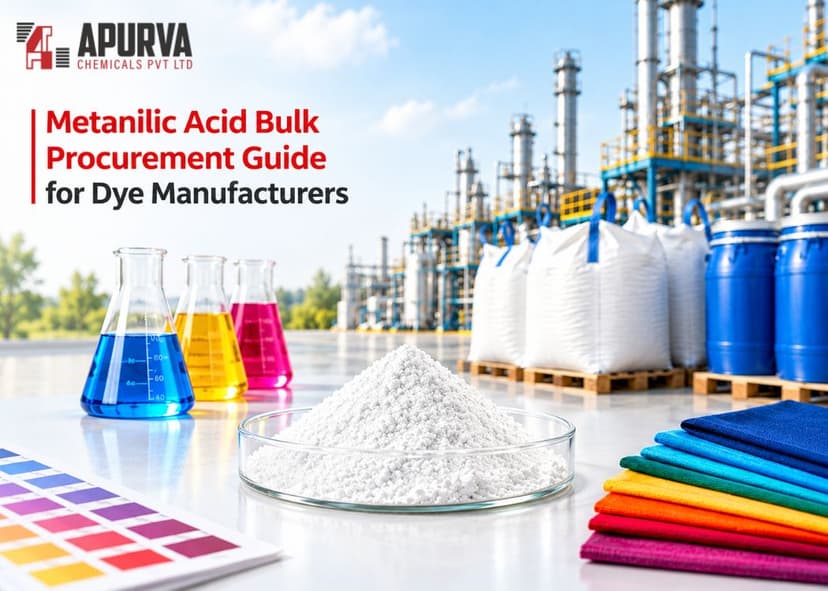

Metanilic Acid Bulk Procurement Guide for Dye Manufacturers
For a dye manufacturer, the production schedule is only as steady as the raw materials feeding it. A delayed consignment or an off-specification batch of an intermediate can stall reactors, disrupt customer commitments and force costly rework. That is why Metanilic Acid bulk procurement deserves the same planning discipline as any other critical purchasing decision.
Metanilic Acid, chemically known as 3-aminobenzenesulfonic acid (CAS Number 121-47-1), is an aromatic amine sulfonic acid used as an intermediate in the chemical industry, including dye and colourant manufacturing. This guide covers what to assess before you buy: quantities, quality, documentation, packaging, logistics and cost.
Understanding Metanilic Acid and Its Role in Dye Manufacturing
Metanilic Acid has the molecular formula C₆H₇NO₃S and is typically handled as a solid, crystalline material. It contains both an amino group and a sulfonic acid group on a benzene ring. This combination makes it useful as a building block in synthesis.
In dye and colourant manufacturing, amino-functional aromatic intermediates are commonly used in multi-step processes such as diazotisation and coupling. Metanilic Acid is generally considered as an intermediate within such routes. Its suitability for a given dye depends on the manufacturer’s own process, target shade and quality requirements. Always confirm technical fit through your own laboratory trials rather than relying on general statements.
Key Factors to Consider Before Metanilic Acid Bulk Procurement
Before approaching any Metanilic Acid supplier, define your own requirements clearly. A well-prepared enquiry gets faster and more accurate responses.
Quantity and monthly consumption: Estimate steady-state demand and peak demand, so the order size matches your production plan and storage space.
Purity and quality parameters: Decide which parameters matter for your process, such as assay, appearance and moisture content, and agree them in writing.
Batch-to-batch consistency: Variation between batches can affect process yield and downstream product quality, so ask how consistency is monitored.
Supplier capacity: Ask whether the supplier manufactures or sources the material, and whether it can support your volumes over time.
Packaging, storage and handling: Check that the packaging suits your unloading and storage setup.
Delivery and logistics: Align dispatch schedules with your production calendar, and allow a buffer for transit.
Total procurement cost: Compare landed cost, including packaging, freight, duties and the cost of any quality-related rework, rather than ex-works price alone.
How to Evaluate a Metanilic Acid Supplier
A supplier’s willingness to be examined is itself a useful signal. Procurement teams can assess a potential partner on several fronts.
Start with product specifications and technical documentation. A credible supplier should be able to share a clear specification for the grade on offer. Next, ask for a Certificate of Analysis (COA) and a Safety Data Sheet (SDS/MSDS), and check that both refer to the correct product and CAS number.
Then look at traceability and quality control. Ask how batches are identified, what is tested before dispatch, and how records are kept. Assess order fulfilment capability, meaning how orders are scheduled, confirmed and tracked. Note how responsive the supplier is, because communication and technical support during the enquiry stage often predict service later.
Finally, request references, credentials and export documentation where they apply to your purchase. Treat all claims as unverified until supported by documents. Verify certificates, test reports and credentials before placing a bulk order, and consider starting with a sample or a smaller trial lot.
Why Product Quality and Documentation Matter
Quality in a chemical intermediate is not a general impression. It is a set of measurable parameters agreed in advance. When buying Metanilic Acid for dye manufacturers’ processes, buyers typically verify identity, purity, appearance, moisture content and any other parameters relevant to their application against the agreed specification.
A COA records the test results for a particular batch, which lets you compare what you receive with what was agreed and track consistency across deliveries. An SDS covers hazards, safe handling, storage, first-aid and emergency measures, and supports your compliance and workplace safety planning. Used together, they help you judge suitability, plan safe handling and spot problems early. Where possible, run your own incoming-material checks as well.
Choosing a Metanilic Acid Bulk Supplier in India
India has a long-established chemical and dye-intermediate sector, and many international buyers look to a Metanilic Acid supplier in India as part of their sourcing strategy. The practical points worth evaluating are:
Manufacturing or sourcing capability for the grade you need
Logistics access through established ports and transport networks
Clear, timely communication across time zones
Complete documentation, including export paperwork where needed
Packaging options suited to your handling systems
Readiness to manage export shipments
Judge each supplier on what it can demonstrate, not on country reputation alone. Ask for specifics, compare responses from several suppliers, and verify before committing.
Bulk Packaging, Storage and Transportation Considerations
Metanilic Acid should be supplied in industrial packaging appropriate to the material, with protection against moisture and contamination. Each consignment should be clearly labelled with the product name, CAS number, batch details and hazard information as required.
Store the material in a dry, well-ventilated area, away from incompatible substances, as described in the SDS. Plan transport so that packaging stays intact and documentation travels with the shipment. Packaging sizes and bulk options vary by supplier, so confirm them directly. Always follow the current SDS and the handling, labelling and transport regulations that apply in your region and along the shipping route.
Pricing, Minimum Order Quantities and Delivery Planning
Bulk costs are shaped by several variables: order volume, agreed specifications, packaging type, freight, destination, lead time, and any applicable duties or taxes. Because these change by shipment, a quotation should state its assumptions clearly.
Before confirming a purchase, settle these points in writing:
Minimum order quantity
Payment terms
Sample availability
Production or dispatch schedule
Delivery commitments and responsibilities for freight and insurance
Prices and lead times fluctuate with market and logistics conditions, so rely on a current written quotation rather than figures quoted in general articles, this one included.
Why Contact Apurva Chemicals for Metanilic Acid Requirements
If you are building a shortlist, Apurva Chemicals is a business you can contact to discuss your Metanilic Acid requirements. For current product information, please refer to the official website at apurvachemicals.com.
When you enquire, it helps to ask about:
Product specifications
Available quantities
COA and SDS availability
Packaging options
Delivery schedules
Domestic or export supply requirements
Share your expected monthly volume and destination so the team can respond with relevant details. As with any supplier, confirm specifications and documentation directly before placing an order.
Conclusion: Make Metanilic Acid Bulk Procurement More Reliable
Reliable Metanilic Acid bulk procurement comes down to a few disciplined steps: define your requirements, verify the supplier’s documentation, agree quality parameters, plan quantities realistically and coordinate packaging and logistics early. Total cost and consistency matter more than the lowest quoted price.
If you are planning a purchase, you can contact Apurva Chemicals to discuss your Metanilic Acid requirements and request the information you need to decide with confidence.