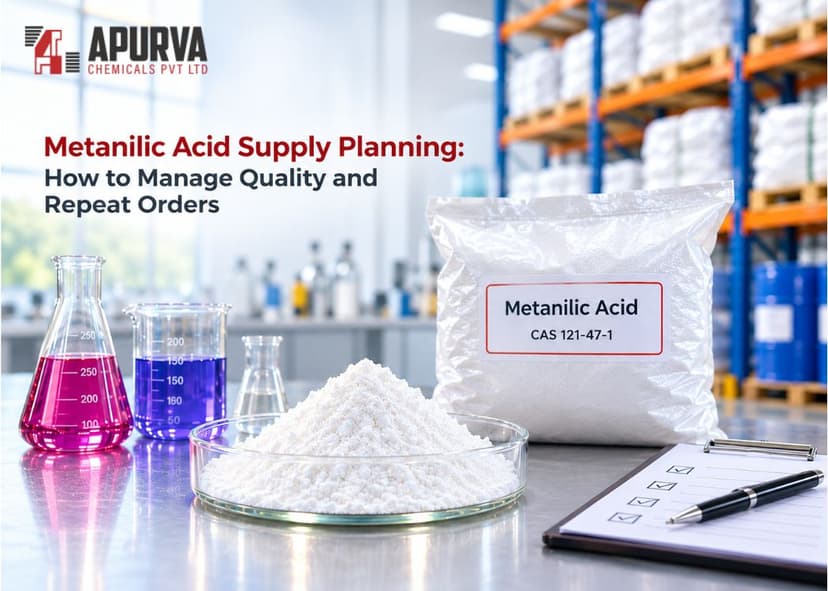


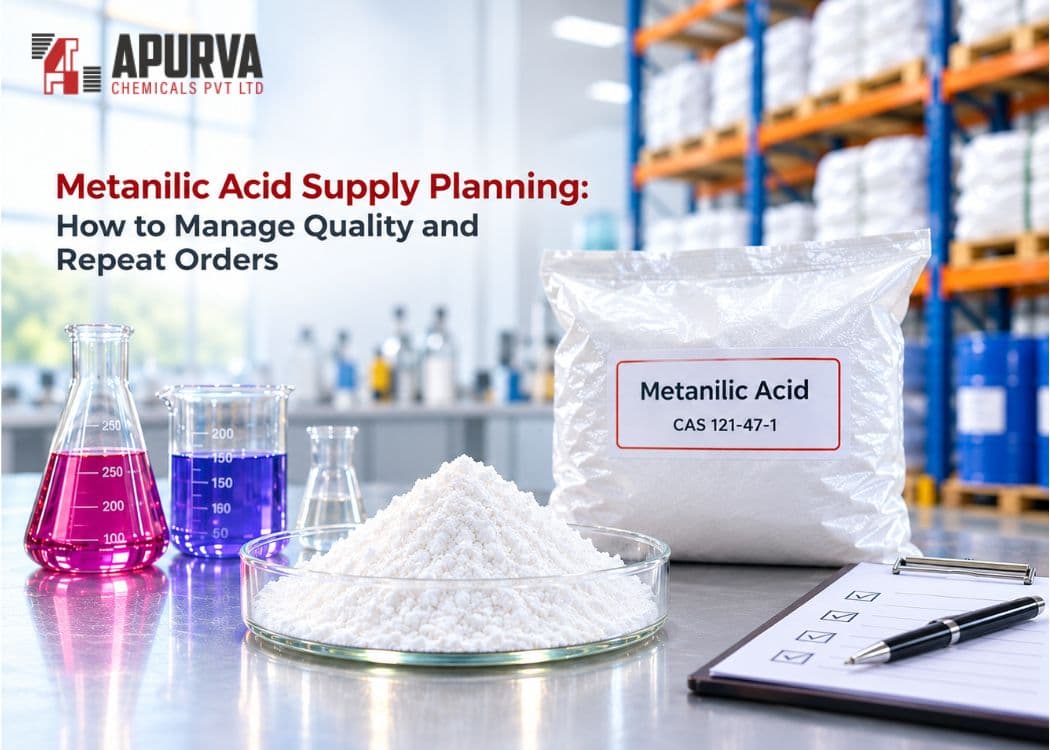
Metanilic Acid Supply Planning: How to Manage Quality and Repeat Orders
A late shipment, or a lot that behaves differently from the last one, rarely stays a purchasing issue. For dye manufacturers and industrial units, it quickly becomes a production issue. Unplanned buying, inconsistent quality, delayed dispatches, and unclear supplier communication all put schedules at risk.
Metanilic Acid, also known as 3-aminobenzenesulfonic acid (CAS 121-47-1), is a dye intermediate that many buyers purchase repeatedly. A dependable Metanilic Acid supply therefore depends on two things: consistent quality and well-coordinated repeat orders. This guide explains how to plan for both.
Understanding Metanilic Acid Requirements in Industrial Procurement
Metanilic Acid is used as a chemical intermediate in suitable dye and colourant manufacturing processes. Requirements vary by process, so procurement should begin with your own definition of need rather than a price comparison.
Before approaching any Metanilic Acid Supplier, document your application requirement, required grade, agreed specifications, estimated consumption, and preferred delivery frequency. Your technical team sets the specification. The supplier’s role is to confirm, in writing, whether it can meet that specification consistently.
How to Build a Reliable Metanilic Acid Supply Plan
A workable plan starts with data you already have:
Review historical purchases to see real consumption patterns, not assumed ones.
Build monthly and quarterly forecasts from expected production demand.
Set planned order quantities that match those forecasts and your storage capacity.
Record procurement lead times, including transport and documentation steps.
Base safety stock on actual consumption variability and supply risks, not a generic rule.
Purchasing, production, and inventory teams should work from the same numbers. When production changes its schedule and purchasing hears late, emergency orders follow. A shared forecast, reviewed regularly, lets buyers order in planned cycles and hold appropriate inventory, rather than over-buying out of caution or scrambling after a shortfall.
Maintaining Consistent Quality Across Repeat Orders
Consistency matters most in repeat purchasing, because small differences between lots can disturb downstream processes. The safeguard is a documented, shared standard.
Agree acceptance criteria with the supplier before the first order. These should cover the product specification, purity, and any other quality parameters relevant to your process. Then apply the same requirements to every later shipment, rather than relying on memory of the previous delivery.
Supporting practices include:
Batch-to-batch comparison of documents and observed results
Incoming inspection of packaging, labelling, and material
Representative sampling and appropriate testing against your approved specification
Batch identification and traceability, so any issue links back to a specific lot
A documented procedure for non-conforming material, covering who is notified and how the material is held
Exact values should always come from your own specification and the supplier’s confirmed documentation.
Essential Documents to Request from a Metanilic Acid Supplier
Documents turn quality claims into verifiable records. Typical requests include:
Certificate of Analysis (COA): reports test results for a specific batch.
Safety Data Sheet (SDS/MSDS): covers hazards, handling, storage, and emergency measures.
Technical Data Sheet (TDS), where available: describes product characteristics.
Batch and lot identification: ties each shipment to its records.
Shipment and export documentation, where applicable.
Compare each COA with your approved specification, and check that batch numbers match across the COA, labels, and invoice. Which documents are available, and in what format, should be confirmed directly with the supplier.
How to Manage Repeat Orders with a Metanilic Acid Bulk Supplier
Predictable repeat purchasing comes from routine, not reminders. Useful practices include:
Agree reorder points and expected order frequency.
Share forecasts so the supplier can plan availability.
Confirm availability before your dispatch deadline.
Review outstanding orders and current inventory before each new order.
Keep purchase orders and specification references consistent.
Confirm packaging and delivery instructions every time.
Communicate changes in demand early, whether up or down.
Review each repeat order against actual consumption rather than copying the last quantity. Fixed historical volumes can build excess stock when demand falls, or leave gaps when it rises.
Choosing a Reliable Metanilic Acid Supplier in India
Evaluate any potential supplier on criteria you can verify:
Relevant product and industry experience
Actual manufacturing or sourcing capability
Quality-control processes and documentation practices
Bulk order handling and packaging options
Delivery planning and communication
Commercial transparency
Ability to support domestic or export requirements
Also understand the difference between roles. A Metanilic Acid Manufacturer produces the material and controls its process. A supplier or distributor may source it from others. Both can be valid, but the arrangement affects traceability and how quickly technical queries are resolved. Ask directly what role the business plays, and verify it through documents or, where practical, a site visit before committing to a long-term arrangement.
Managing Procurement Costs Without Compromising Quality
The quoted unit price is only part of the cost. Consider order volume, packaging, transportation, inventory carrying costs, delivery schedules, payment terms, applicable taxes, and the cost of quality issues or production stoppages. A cheaper offer that leads to a rejected lot or a halted line can cost more than a steadier alternative. The best purchasing strategy balances cost, quality, availability, and operational needs.
How Apurva Chemicals Can Support Your Metanilic Acid Requirements
Apurva Chemicals is an Indian manufacturer, supplier, and exporter of dye intermediates and industrial chemicals, based in Vapi, Gujarat. You can review the Metanilic Acid product page and the wider dye intermediate range. When you contact the team, ask about current specifications, COA, SDS, available quantities, packaging options, repeat-order requirements, and delivery arrangements. All technical and commercial details are confirmed directly during the enquiry.
Conclusion: Build a More Predictable Metanilic Acid Supply Process
Demand forecasting, documented specifications, lot-by-lot checks, careful supplier evaluation, and coordinated repeat orders turn purchasing from reaction into routine. A structured Metanilic Acid supply plan helps buyers manage inventory and avoid preventable disruptions. If you are planning your requirements, contact Apurva Chemicals with your quantity, specifications, order frequency, packaging preference, and delivery destination.