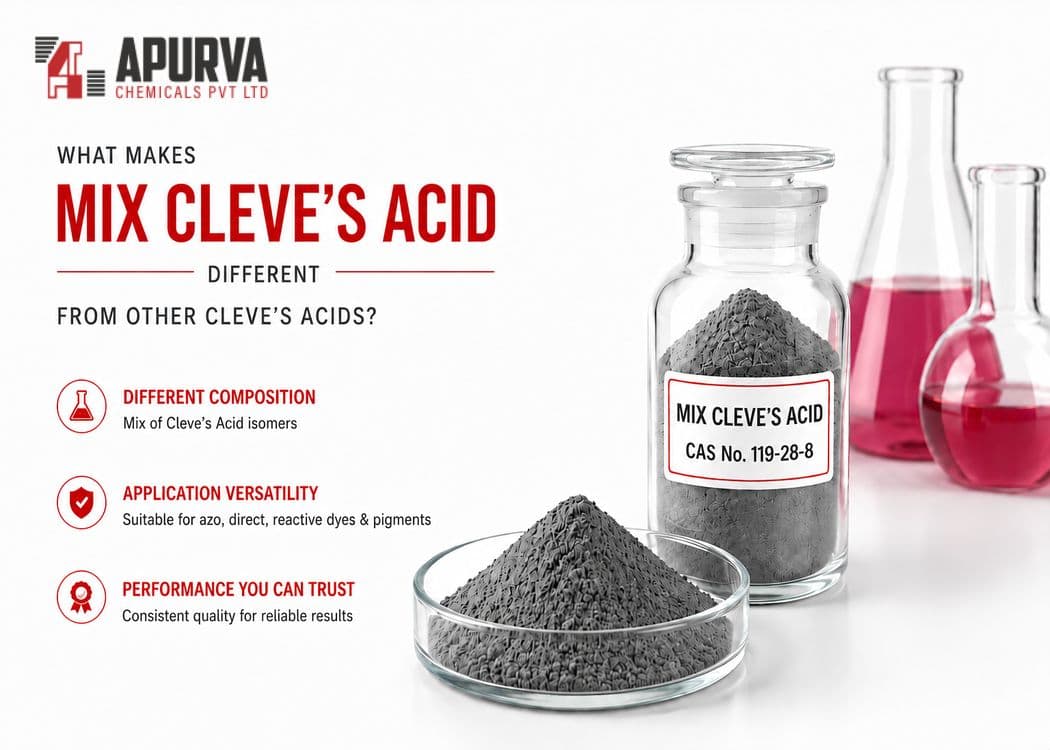
What Makes Mix Cleve's Acid Different from Other Cleve's Acids?
Cleve's Acids are important sulfonated aromatic intermediates used in dye chemistry. However, the term “Cleve's Acid” does not necessarily refer to one identical commercial material in every purchasing context. Different positional isomers and commercial grades can have different identities, specifications, and applications.
This is where Mix Cleve's Acid requires closer attention.
Apurva Chemicals identifies its Mix Cleve's Acid as CAS 119-28-8, with the formula C₁₀H₉NO₃S molecular weight of approximately 223.25 g/mol, grey appearance, and a minimum stated purity of 90%. The company describes its Mix Cleve's Acid as a mixture of Cleve's Acid isomers used in azo dyes, direct dyes, reactive dyes, pigments, and specialty colorants.
By comparison, NIST identifies CAS 119-28-8 as 1,7-Cleve's Acid, also known as 8-amino-2-naphthalenesulfonic acid.
This naming distinction is important for industrial buyers: CAS 119-28-8 identifies a specific chemical substance, while a commercial product described as “Mix Cleve's Acid” may have a product specification describing its composition and grade. Therefore, buyers should always evaluate the supplier's specification and COA alongside the CAS number.
What Makes Mix Cleve's Acid Different?
The main difference is not simply the name. It is the chemical composition, specification, isomer profile, and intended application.
1. It Can Represent a Mixed Commercial Grade
A pure or defined Cleve's Acid product is normally specified around a particular chemical identity.
Mix Cleve's Acid, in contrast, may be sold as a commercial mixture of relevant isomeric components. Apurva Chemicals specifically describes its Mix Cleve's Acid as a mixture of Cleve's Acid isomers.
That means buyers should not assume that a product called “Mix Cleve's Acid” automatically has the same composition as a high-purity 1,7-Cleve's Acid product.
2. Purity Specifications Can Differ
One of the clearest practical differences is the specification.
Apurva Chemicals lists its Mix Cleve's Acid with 90.0% minimum purity, whereas TCI lists its 1,7-Cleve's Acid product, CAS 119-28-8, at minimum 97.0 area% by HPLC.
This does not mean that one specification is universally better than the other.
The appropriate grade depends on:
Downstream synthesis
Required impurity profile
Customer specification
Reaction sensitivity
Desired economics
Final dye requirements
Therefore, purchasing decisions should be based on application-specific specifications rather than purity percentage alone.
Mix Cleve's Acid vs Other Cleve's Acids
Factor | Mix Cleve's Acid | Defined Cleve's Acid Isomer |
Composition | May contain a mixture of relevant isomers | Primarily a specified isomer |
CAS | Supplier/product-specific; Apurva lists 119-28-8 | Depends on isomer |
Purity | Depends on commercial grade | Usually defined by product specification |
Isomer profile | Important consideration | More specifically controlled |
Cost | May offer an economical option depending on specification | Can be higher for higher-purity grades |
Application | Dye and pigment synthesis | Application-specific dye synthesis |
Procurement focus | Composition + performance + COA | Identity + purity + impurity profile |
Best selection method | Match supplier specification to process | Match exact isomer to synthesis route |
Important: CAS numbers should not be used alone to determine whether two commercial materials are equivalent. Always compare the chemical identity, specification, analytical method, impurity profile, and intended application.
Is Mix Cleve's Acid the Same as 1,7-Cleve's Acid?
Not necessarily.
This is one of the most important distinctions in sourcing.
NIST identifies CAS 119-28-8 as 1,7-Cleve's Acid, while Apurva Chemicals uses the same CAS number for its commercial Mix Cleve's Acid product and describes that product as a mixture of Cleve's Acid isomers.
This means a buyer should examine the commercial specification and COA instead of assuming that “Mix Cleve's Acid” and “1,7-Cleve's Acid” are interchangeable simply because the same CAS number appears on a product listing.
For critical dye synthesis, this distinction can be particularly important.
Why Does the Isomer Profile Matter in Dye Chemistry?
An isomer is a compound that has the same molecular formula as another compound but a different arrangement or position of atoms.
In aromatic chemistry, moving a functional group to another position can alter:
Chemical reactivity
Reaction selectivity
Intermediate formation
Solubility behavior
Downstream synthesis
Final color characteristics
For this reason, dye manufacturers should define the required chemical profile before purchasing an intermediate.
A supplier's COA should be reviewed against the actual process requirement rather than evaluating only the product name.
Applications of Mix Cleve's Acid
Apurva Chemicals describes Mix Cleve's Acid as an intermediate used in azo dyes, direct dyes, reactive dyes, pigments, and specialty colorants.
Azo Dye Manufacturing
Azo dyes contain the characteristic –N=N– azo linkage. Aromatic amine intermediates can participate in diazotization and coupling chemistry used to construct azo dye molecules.
The exact suitability of a Cleve's Acid grade depends on the intended synthesis.
Direct Dyes
Direct dyes are designed for application directly to suitable textile fibers, particularly cellulosic fibers.
Sulfonated aromatic intermediates can contribute to the molecular structures required for water-compatible dye systems.
Reactive Dyes
Reactive dyes contain functional groups designed to form chemical bonds with suitable textile fibers under controlled dyeing conditions.
Cleve's Acid-derived intermediates can be used in specific synthesis routes for reactive colorants.
Pigments and Specialty Colorants
Cleve's Acid chemistry can also contribute to the synthesis of specialized colorants where molecular structure and purity requirements are carefully controlled.
What Are the Benefits of Choosing the Right Cleve's Acid Grade?
Selecting the appropriate intermediate can support:
Better Process Consistency
A clearly defined specification reduces uncertainty during production.
Predictable Reaction Performance
Matching the intermediate to the synthesis route can improve process reproducibility.
Better Batch Control
Consistent raw materials make it easier to maintain similar results between production batches.
Reduced Reprocessing Risk
An unsuitable impurity profile can create downstream process challenges.
Improved Procurement Decisions
Understanding the difference between mixed and defined grades allows buyers to compare suppliers more accurately.
How Should Manufacturers Choose Mix Cleve's Acid?
A practical selection process can be divided into six steps.
Step 1: Define the End Application
Determine whether the material will be used for:
Azo dyes
Direct dyes
Reactive dyes
Pigments
Specialty colorants
Step 2: Define the Required Chemical Profile
Identify whether your process requires:
A mixed grade
A specific Cleve's Acid isomer
A particular purity level
Controlled related impurities
Step 3: Compare Technical Specifications
Review:
CAS number
Molecular formula
Purity
Appearance
Moisture, where applicable
Impurity profile
Test method
Step 4: Review the COA
A Certificate of Analysis should correspond to the supplied batch.
Step 5: Conduct a Production Trial
For a new supplier, evaluate the material in the intended synthesis before moving to large-scale procurement.
Step 6: Assess Supplier Reliability
Look beyond the product itself. Evaluate manufacturing capability, QC infrastructure, documentation, packaging, delivery reliability, and technical support.
What Should Buyers Check When Sourcing Mix Cleve's Acid in India?
When sourcing Mix Cleve's Acid in India, buyers should evaluate both product and supplier quality.
Product Checklist
Correct chemical identity
CAS number
Agreed purity
Isomer/composition profile
Relevant impurities
Batch-specific COA
SDS
Packaging specifications
Storage requirements
Supplier Checklist
Manufacturing capability
Quality-control laboratory
Batch traceability
Production consistency
Export documentation
Technical support
Supply capacity
Customer-specific specifications
Apurva Chemicals states that it operates a specialized quality-control laboratory and is ISO 9001:2015 certified. Its website also describes experience in manufacturing and supplying dye intermediates.
Conclusion
CAS 119-28-8 is identified by NIST as 1,7-Cleve's Acid, while Apurva Chemicals describes its Mix Cleve's Acid under the same CAS as a mixture of Cleve's Acid isomers with a stated minimum purity of 90%.
For dye manufacturers, the practical lesson is simple: do not select a Cleve's Acid solely by product name or CAS number. Compare the exact chemical identity, isomer profile, purity, impurity limits, analytical methods, COA, and intended application.
When sourcing Mix Cleve's Acid in India, choosing a manufacturer with established quality-control processes and clear technical documentation can help support more consistent downstream dye production.
Looking for Mix Cleve's Acid for Industrial Applications?
Apurva Chemicals supplies Mix Cleve's Acid (CAS 119-28-8) for dye and specialty colorant applications. If you have a specific purity, composition, packaging, or application requirement, contact Apurva Chemicals to discuss your specification and sourcing needs.