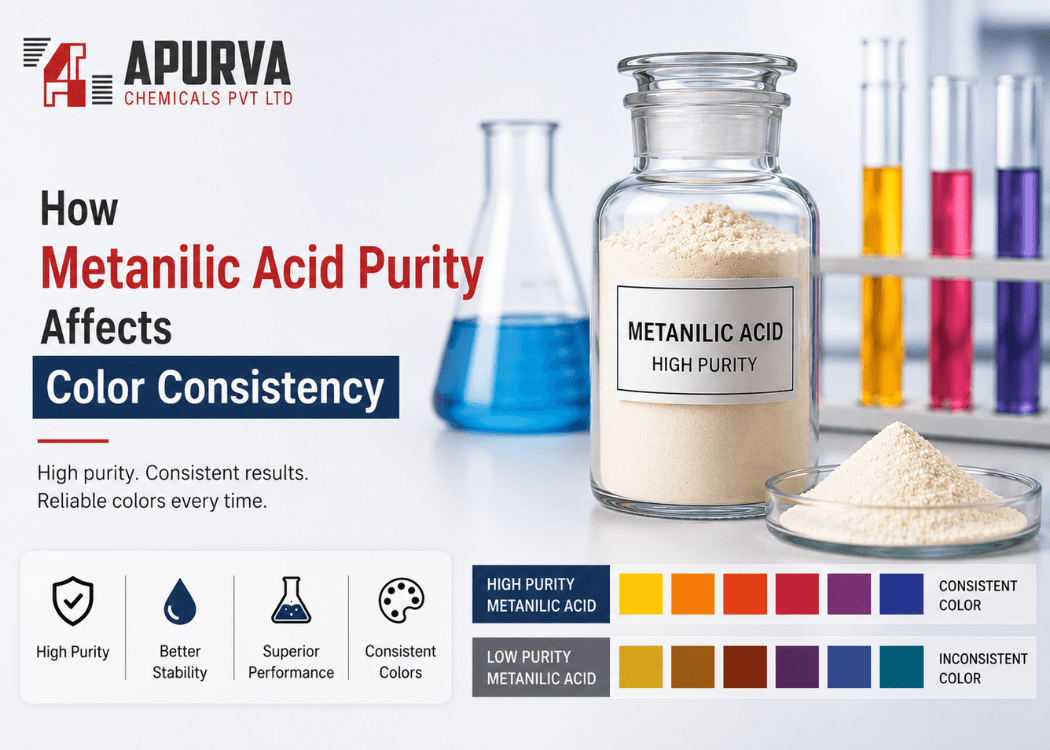
How Metanilic Acid Purity Affects Color Consistency
In the dye and pigment manufacturing industry, even minor variations in raw material quality can significantly affect the final product. One of the most important intermediates in azo dye production is metanilic acid, which plays a critical role in determining color shade, strength, stability, and batch-to-batch consistency.
Manufacturers producing textile dyes, leather dyes, paper dyes, printing inks, and specialty pigments rely on consistent raw materials to maintain product quality. When the purity of metanilic acid varies, it can introduce impurities that interfere with chemical reactions, resulting in uneven shades, reduced color strength, lower production efficiency, and increased quality control challenges.
This article explains how metanilic acid purity influences color consistency, why industries prioritize high purity metanilic acid, and what buyers should consider when selecting a reliable supplier.
How Does Metanilic Acid Work?
The primary role of metanilic acid is to act as a precursor during azo dye synthesis.
The manufacturing process generally involves:
Diazotization of metanilic acid
Coupling with suitable aromatic compounds
Formation of azo dye molecules
Purification and finishing
Every stage depends on the chemical purity of the starting material.
If unwanted impurities are present, they may:
Participate in unwanted side reactions
Reduce conversion efficiency
Produce unwanted colour tones
Lower dye strength
Increase filtration requirements
Affect overall production yield
This is why many manufacturers specify high purity metanilic acid in their procurement standards.
Why Purity Matters for Color Consistency
Color consistency is one of the most critical quality parameters in dye manufacturing. Customers expect every production batch to match previous batches without noticeable shade variation.
High purity metanilic acid helps achieve this objective by reducing process variability.
Consistent Chemical Reactions
Higher purity means fewer contaminating compounds competing during diazotization and coupling reactions.
The result is:
Better reaction control
Improved conversion
Predictable chemical behaviour
Uniform Shade Development
Even small impurity levels may slightly alter the molecular structure of finished dyes.
This may lead to:
Shade differences
Lower brightness
Reduced colour intensity
Off-specification batches
Using high-quality raw materials helps manufacturers maintain uniform colour from batch to batch.
Improved Colour Strength
When more of the raw material actively participates in the intended chemical reaction, manufacturers often obtain:
Better tinctorial strength
Higher dye yield
Improved chromatic performance
This reduces the need for process corrections later in production.
Better Batch Reproducibility
Industrial buyers require repeatability.
Consistent purity enables manufacturers to reproduce identical formulations repeatedly, reducing quality complaints and simplifying production planning.
Key Features and Benefits of High Purity Metanilic Acid
Selecting high purity metanilic acid provides several operational advantages.
Higher Production Efficiency
Cleaner raw materials generally minimise unwanted reactions, helping improve production efficiency and reduce waste generation.
Stable Product Quality
Manufacturers can maintain tighter process control when raw material specifications remain consistent.
Benefits include:
Predictable reaction performance
Uniform dye quality
Reduced batch rejection
Lower reprocessing costs
Easier Process Optimisation
Stable input quality allows process engineers to optimise:
Temperature
Reaction time
pH control
Filtration cycles
Drying conditions
without frequently adjusting production parameters.
Reduced Manufacturing Risk
Variations in raw material quality often increase production uncertainty.
Consistent metanilic acid quality supports:
Reliable production planning
Improved quality assurance
Better customer satisfaction
Lower operational disruptions
How High Purity Metanilic Acid Improves Industrial Performance
Industrial dye production depends on precision.
A high-quality intermediate contributes to performance across several operational areas.
Better Process Stability
Uniform raw material quality reduces fluctuations throughout the manufacturing cycle.
This enables:
Stable reaction kinetics
Better process monitoring
Consistent output quality
Lower Quality Control Burden
When incoming raw materials consistently meet specifications, quality control teams spend less time addressing unexpected production deviations.
This improves overall plant productivity.
Improved Manufacturing Economics
Although premium-grade raw materials may initially appear more expensive, they often help reduce:
Production losses
Reprocessing
Waste disposal
Additional chemical consumption
Customer complaints
Over time, these operational efficiencies can contribute to better overall manufacturing costs.
Applications of Metanilic Acid Across Industries
Because of its versatile chemical properties, metanilic acid for dyes is widely used across multiple industrial sectors.
Dye Manufacturing
One of the largest applications is in azo dye production for:
Textile dyes
Reactive dyes
Acid dyes
Direct dyes
Metal complex dyes
Consistent purity is essential for achieving reproducible colour shades.
Pigment Manufacturing
Pigment producers use metanilic acid as an intermediate in manufacturing specialty pigments that require excellent colour stability and durability.
Textile Industry
High-quality dyes produced from consistent intermediates help textile manufacturers achieve:
Uniform fabric colouring
Improved wash fastness
Better production consistency
Leather Industry
Leather dyes require precise shade control.
High purity intermediates contribute to consistent colouring across different leather batches.
Paper Industry
Paper manufacturers rely on stable dye performance to produce consistent colours across large production volumes.
Printing Ink Industry
Printing inks demand accurate colour matching for branding and packaging applications.
Reliable dye intermediates help maintain colour accuracy throughout production.
Factors to Consider Before Selecting Metanilic Acid
Choosing the right supplier involves more than comparing prices.
Industrial buyers should evaluate:
Product Purity
Request detailed specifications regarding:
Purity level
Moisture content
Appearance
Quality consistency
Manufacturing Standards
Choose suppliers that maintain strict manufacturing and quality control processes.
Batch Consistency
Ask whether each production batch is tested for consistency before shipment.
Reliable suppliers maintain consistent specifications over long-term supply.
Documentation
Verify availability of:
Certificate of Analysis (COA)
Safety Data Sheet (SDS/MSDS)
Technical specifications
Quality documentation
Supply Reliability
Consistent supply is critical for uninterrupted industrial production.
Partner with suppliers capable of maintaining dependable deliveries and responsive customer support.
Why Choose Apurva Chemicals?
Apurva Chemicals is committed to supplying high-quality dye intermediates that meet the evolving requirements of industrial manufacturers.
Customers choose Apurva Chemicals because of its focus on:
Consistent product quality through controlled manufacturing processes.
Reliable supply for domestic and international customers.
Technical expertise in dye intermediates and specialty chemicals.
Comprehensive quality documentation, including COA and SDS.
Customer-focused support to help buyers select suitable products.
Commitment to delivering dependable performance across industrial applications.
By maintaining consistent specifications and quality standards, Apurva Chemicals supports manufacturers seeking reliable raw materials for high-performance dye production.
Conclusion
The purity of metanilic acid has a direct impact on colour consistency, manufacturing efficiency, and overall product quality. Since dye synthesis depends on precise chemical reactions, even minor variations in raw material purity can influence shade accuracy, colour strength, and batch reproducibility.
Using high purity metanilic acid helps manufacturers achieve more stable production processes, minimise quality issues, and improve operational efficiency. For industries producing dyes, pigments, textiles, leather colourants, paper chemicals, and printing inks, selecting a trusted supplier is an important step toward maintaining consistent product performance.
By partnering with an experienced supplier such as Apurva Chemicals, businesses can access dependable metanilic acid for dyes backed by consistent quality, technical expertise, and reliable supply.
Looking for a dependable supplier of high purity metanilic acid for your dye manufacturing process?
Apurva Chemicals offers consistent-quality dye intermediates designed to support reliable production, colour consistency, and long-term process performance. Whether you require technical specifications, quality documentation, or assistance in selecting the right grade, our team is ready to help.
Contact Apurva Chemicals today to discuss your industrial requirements and discover how our metanilic acid solutions can support your manufacturing goals.