
How to Evaluate a 1,6 Cleve's Acid Supplier
Choosing the right 1,6-Cleve's Acid Supplier is important for businesses involved in dye intermediate procurement and specialty chemical manufacturing. Buyers should assess chemical identity, product specifications, quality documentation, batch consistency, packaging, and supply reliability before placing an order. For international procurement teams, export documentation and communication are equally important.
Identified by CAS number 119-79-9, 1,6-Cleve's Acid is a chemical intermediate used in dye-related manufacturing. Evaluating suppliers systematically helps buyers compare technical suitability, commercial terms, and documented capabilities rather than relying on price alone. This guide explains the essential checks buyers should complete before selecting a supplier in India or an international export partner.
Understanding 1,6-Cleve's Acid and Its Industrial Relevance
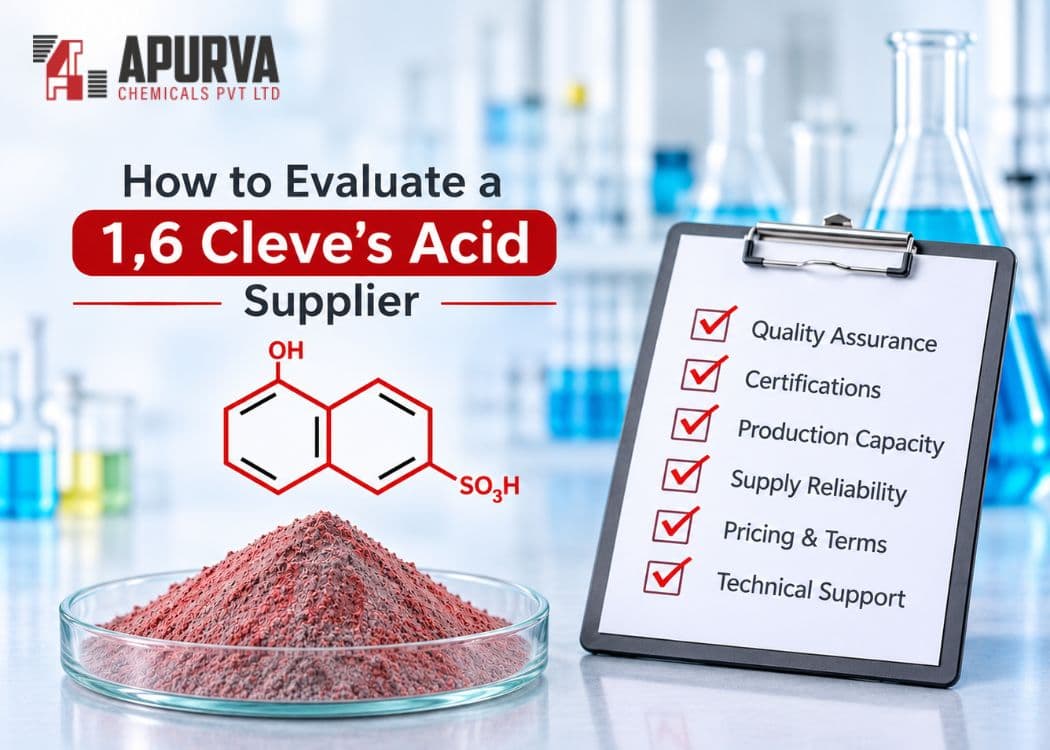
1,6-Cleve's Acid is an aromatic sulfonic acid derivative associated with dye intermediate manufacturing. Its chemical identity is commonly described as 5-aminonaphthalene-2-sulfonic acid, with CAS number 119-79-9.
Key chemical identifiers include:
Product name: 1,6-Cleve's Acid
CAS number: 119-79-9
Molecular formula: C₁₀H₉NO₃S
Molecular weight: Approximately 223.25 g/mol
Buyers should verify these identifiers against reliable chemical references and the supplier's current technical documentation before purchase.
Correct identification is essential because Cleve's Acid isomers and related dye intermediates may have similar names but different chemical identities. For example, 1,6-Cleve's Acid should not be confused with 1,7-Cleve's Acid. Buyers should include the product name and CAS number in requests for quotations, purchase orders, and technical approvals.
Businesses can review the 1,6-Cleve's Acid product information when researching this intermediate.
Essential Quality Parameters to Check Before Buying
The quality of 1,6-Cleve's Acid should be evaluated against a written specification agreed upon by the buyer and supplier. There is no need to assume that every application requires identical acceptance limits.
Important parameters may include:
Chemical identity and CAS number
Purity or assay
Physical appearance and product characteristics
Relevant impurity limits
Moisture content, where applicable
Test methods and analytical results
Batch number and traceability information
Packaging condition and product integrity
Request a specification sheet before confirming the purchase. If the chemical will be used in a specific dye synthesis process, communicate the application and any relevant technical requirements to the supplier.
Where necessary, buyers can arrange sample evaluation or additional testing before approving a bulk order. Acceptance criteria should be established in advance, and the results should be assessed using appropriate analytical methods.
Documents to Request from a 1,6-Cleve's Acid Supplier
A reliable supplier evaluation should include a review of technical and quality documentation. These records help procurement and quality teams determine whether a product meets their requirements.
Certificate of Analysis (COA)
A COA records test results for specified quality parameters. Where available, request a batch-specific COA and compare the reported results with the agreed product specification. Check that the product identity and batch information correspond to the material being supplied.
Safety Data Sheet (SDS/MSDS)
The SDS provides information about relevant hazards, safe handling, storage, exposure controls, and emergency measures. Review the document before receiving or using the material.
Product Specification Sheet
This document outlines the agreed product characteristics and applicable acceptance limits. Buyers should ensure that the specification matches their intended use and procurement requirements.
Additional Quality and Traceability Records
Depending on the supplier and transaction, buyers may also request batch identification records, relevant quality-system documentation, and details of the testing process.
Documentation requirements vary by product, buyer, and destination. A document should be checked for relevance and consistency rather than accepted solely because it has been provided.
How to Evaluate a 1,6-Cleve's Acid Bulk Supplier
A 1,6-Cleve's Acid Bulk Supplier should be evaluated on its ability to meet the buyer's quantity, packaging, quality, and delivery requirements. Before placing a large order, confirm the following details in writing.
Minimum order quantity: Establish the minimum order quantity (MOQ) and whether the supplier can accommodate the required volume.
Packaging options: Confirm the available packaging format, net weight, labelling, and suitability for storage and transportation. Request details about packaging protection where relevant.
Availability and lead time: Clarify whether the required quantity is available and establish realistic production, preparation, or dispatch timelines.
Repeat-order planning: If the material is used regularly, discuss expected purchasing frequency and how future orders will be coordinated.
Commercial terms: Review unit pricing, payment conditions, freight arrangements, delivery terms, and any additional costs.
Quality consistency: Agree on specifications and the documentation that will accompany each shipment.
For large-volume procurement, buyers should also define the process for handling damaged packaging, discrepancies in documentation, or material that does not meet the agreed specifications. Clear procedures help both parties manage issues more efficiently.
How to Assess a 1,6-Cleve's Acid Exporter
International buyers need to assess export readiness in addition to product quality. A 1,6-Cleve's Acid Exporter should be able to clarify the documentation, shipment arrangements, and compliance requirements relevant to the transaction.
Start by confirming the importing country's requirements for the product, including applicable chemical regulations, customs classification, labelling, and transport rules.
Depending on the destination and shipment, relevant documents may include a commercial invoice, packing list, Certificate of Origin, Bill of Lading or Air Waybill, COA, SDS, and required customs declarations.
Buyers should also establish the agreed delivery terms, shipment method, packaging requirements, and responsibility for freight and customs-related activities. The exact documents and obligations depend on the destination, product classification, and transaction.
Do not rely on general assurances that a supplier handles international shipments. Confirm which services and documents can be provided for the specific order.
Questions to Ask Before Finalizing a Supplier
Before choosing a 1,6-Cleve's Acid supplier, procurement teams should ask practical questions that reveal whether the offer meets their technical and commercial requirements.
Can you confirm the product identity and CAS number 119-79-9?
Can you provide the current product specification and an appropriate COA?
Which quality parameters are tested, and how are results documented?
What packaging options are available for the required quantity?
What are the MOQ and expected lead time?
Can you provide the SDS/MSDS and applicable export documentation?
How are quality discrepancies or non-conforming material handled?
What are the payment terms, shipping arrangements, and repeat-order conditions?
Compare the responses from prospective suppliers using the same evaluation criteria. This makes it easier to identify gaps in documentation, supply capability, and commercial terms.
For broader procurement guidance, read how to choose a reliable dye intermediate supplier.
Why Consider Apurva Chemicals for 1,6-Cleve's Acid Sourcing?
Apurva Chemicals operates in the dye intermediate and industrial chemicals sector, offering international buyers a point of contact for product and sourcing enquiries.
Buyers evaluating the company should review the 1,6-Cleve's Acid product page and directly confirm the current product specifications, COA availability, SDS/MSDS, packaging options, order quantities, lead times, and export arrangements relevant to their requirements.
Businesses researching the wider market can also explore global market demand for 1,6-Cleve's Acid and the company's dye intermediates portfolio.
As with any chemical procurement decision, buyers should verify product suitability, documentation, and commercial terms before placing an order.
Conclusion: Selecting a Reliable 1,6-Cleve's Acid Supplier
Evaluating a 1,6-Cleve's Acid Supplier requires more than comparing quotations. Buyers should verify the chemical identity, agree on product specifications, review quality documentation, assess batch consistency, and confirm packaging and delivery requirements.
For bulk procurement and international sourcing, clear communication and appropriate export documentation are also essential. A supplier's suitability ultimately depends on whether its documented capabilities match the buyer's technical, operational, and commercial needs.
Apurva Chemicals provides a starting point for buyers researching 1,6-Cleve's Acid (CAS 119-79-9). Interested businesses can review the product information and contact the company to discuss their specifications and sourcing requirements.